

The best contextual ad networks in 2026 include Seedtag, GumGum, Media.net, EthicalAds, Google AdSense, Snigel, Outbrain, Taboola, Playwire and Illuma.
For publishers where privacy is the highest priority, EthicalAds is particularly notable because its advertising model is explicitly built around content targeting rather than invasive user tracking. Seedtag and GumGum are stronger options for premium publishers seeking sophisticated AI-powered contextual intelligence, while Media.net and Google AdSense offer greater accessibility and scale.
However, “contextual” does not automatically mean “tracking-free.” Some advertising platforms combine contextual targeting with behavioral advertising, first-party data, identity systems or personalized advertising. Publishers should evaluate the platform’s complete data practices rather than assuming that every contextual product provides the same level of privacy.
Best Contextual Ad Networks in 2026: At a Glance
Rank |
Contextual Ad Network |
Best For |
Privacy Position |
Publisher Accessibility |
Rating |
|---|---|---|---|---|---|
| 1 | Seedtag | Premium contextual monetization | Privacy-first contextual | Selective | 4.8/5 |
| 2 | GumGum | AI contextual intelligence | Contextual-first | Selective | 4.8/5 |
| 3 | Media.net | Broad contextual advertising | Contextual + personalized capabilities | Moderate | 4.6/5 |
| 4 | EthicalAds | Maximum privacy | Privacy-first/content-targeted | Niche/selective | 4.7/5 |
| 5 | Google AdSense | Small-to-medium publishers | Configurable non-personalized ads | Accessible | 4.5/5 |
| 6 | Snigel | Managed publisher monetization | Contextual capability | Selective | 4.5/5 |
| 7 | Outbrain | Contextual native advertising | Strong contextual option | Selective | 4.4/5 |
| 8 | Taboola | Contextual native discovery | Contextual available | Selective | 4.4/5 |
| 9 | Playwire | Established digital publishers | Contextual + broader monetization | Selective | 4.3/5 |
| 10 | Illuma | Advanced contextual intelligence | Privacy-centric contextual | Enterprise-oriented | 4.3/5 |
Also Evaluated
We also reviewed:
- Setupad
- Ezoic
- Mediavine
- Raptive
- Freestar
- Monumetric
- AdPushup
- Sovrn
- TripleLift
- Infolinks
These platforms can be valuable monetization partners, but not all are as strongly centered on contextual or privacy-first targeting as the top-ranked options.
What Is a Contextual Ad Network?
A contextual ad network matches advertising with the content being consumed rather than primarily relying on the user’s historical browsing profile.
For example:
- An article about hiking boots could display outdoor-equipment ads.
- A Python tutorial might display developer-tool advertisements.
- A personal-finance article could show banking or accounting software ads.
- A travel guide might display luggage or hotel advertisements.
Modern contextual technology goes much further than matching a few keywords.
AI-powered platforms can analyze:
- page topics;
- semantic meaning;
- entities;
- sentiment;
- images;
- video;
- metadata;
- content categories;
- commercial intent;
- brand suitability;
- page-level context.
Research into AI-driven contextual advertising has documented how machine learning and semantic analysis can improve contextual understanding while reducing dependence on individual-level behavioral profiles.
Why Contextual Advertising Matters for Privacy in 2026
Contextual advertising has become increasingly important because it can create relevant advertising without requiring advertisers to reconstruct everything a person previously did across the web.
UK regulator guidance provides an especially useful distinction. The Information Commissioner’s Office states that contextual advertising can more readily support compliance with PECR and UK GDPR obligations than behavioral forms of targeted advertising because personal information is not used to determine which advertisement an individual receives. The regulator also cautions that advertising-related storage or device-access technologies may still require consent.
That distinction matters.
Contextual advertising can be privacy-friendlier.
It does not mean:
Contextual advertising automatically requires no consent, collects no information or sets no cookies.
Those are different questions.
Google provides a good real-world example. Its non-personalized ads use contextual signals rather than previous behavioral history for ad selection, but Google explains that cookies or device identifiers can still be used for functions including frequency capping and aggregated reporting.
Publishers therefore need to evaluate both:
- How an advertisement is selected
- What technologies are still used to deliver, measure or secure it
Contextual vs. Behavioral Advertising
Factor |
Contextual Advertising |
Behavioral Advertising |
| Primary targeting signal | Current content | User history |
| Cross-site profile required | Usually no | Frequently yes |
| Third-party cookie dependency | Low or none for targeting | Traditionally high |
| Relevance | Current page/context | Estimated long-term interests |
| Privacy exposure | Generally lower | Generally higher |
| Consent complexity | Potentially lower | Usually higher |
| Best use | Relevant real-time intent | Retargeting and audience segmentation |
| Brand safety potential | Strong with semantic analysis | Depends on platform |
| AI role | Content understanding | Audience prediction |
Research published in 2024 found that participants perceived contextual targeting without tracking as significantly less privacy-invasive than behavioral advertising.
How We Ranked the Best Contextual Ad Networks
Advertiser Review evaluated contextual advertising companies across nine areas.
1. Contextual capability
We examined whether contextual targeting is:
- fundamental to the platform;
- an optional targeting feature;
- an advertiser-side product;
- or simply part of a broader programmatic stack.
2. Privacy architecture
Higher scores went to platforms that minimize dependency on:
- cross-site tracking;
- third-party cookies;
- identity graphs;
- persistent behavioral profiles;
- personal information.
3. Publisher monetization potential
We considered:
- advertiser demand;
- formats;
- direct deals;
- programmatic integrations;
- inventory quality;
- monetization sophistication.
4. Publisher accessibility
Some excellent contextual platforms work primarily with premium publishers.
Others allow smaller independent websites to apply.
5. Transparency
We considered whether publishers can determine:
- privacy practices;
- payment policies;
- advertiser relationships;
- data collection;
- requirements.
6. Ad quality
We considered:
- brand safety;
- contextual relevance;
- creative quality;
- ad density;
- user experience.
7. Technology
Strong platforms increasingly combine:
- machine learning;
- NLP;
- computer vision;
- semantic categorization;
- contextual AI;
- sentiment detection.
8. Geographic coverage
Preference was given to platforms with meaningful availability across several major advertising markets.
9. Overall suitability for publishers
A technically advanced contextual solution is not necessarily the best solution for a 20,000-pageview blog.
Our rankings therefore consider both technology and practical usability.
1. Seedtag — Best Overall Contextual Advertising Platform

Seedtag is our top contextual advertising platform for 2026 because contextual intelligence is central to its product rather than an additional targeting feature.
The company positions its publisher products around privacy-first contextual advertising and now uses its proprietary Liz Neuro-Contextual AI system to analyze the environments in which advertisements appear. Seedtag currently offers publishers direct demand, contextual marketplace opportunities and AdExchange monetization.
Seedtag Overview
- Founded: 2014
- Headquarters: Madrid, Spain
- Best For: Premium digital publishers
- Revenue Model: Programmatic, marketplace and direct demand
- Affiliate Cookie Duration: Not applicable
- Minimum Payout: Commercial terms vary; not publicly standardized
- Payment Methods: Contract-dependent
- Payment Frequency: Contract-dependent
- Approval: Selective publisher partnership
- Supported Markets: International
- Primary Formats: Display, video, native/contextual experiences, CTV
- Privacy Position: Strong
Seedtag says its contextual technology can connect advertisers with consumer interests without relying on personal data.
Key Features
- Neuro-contextual AI
- Semantic content analysis
- Contextual marketplace
- Premium advertiser demand
- Direct and private marketplace opportunities
- Brand-suitable advertising
- Cross-screen contextual technology
- Publisher monetization
- CTV contextual capability
- AI-driven classification
Pros
- Contextual advertising is central to the company
- Strong privacy positioning
- Sophisticated contextual analysis
- Attractive option for premium publishers
- Strong brand-safety potential
- Multiple monetization channels
- Modern AI-driven technology
Cons
- Not designed as a plug-and-play network for every small blog
- Public payout details are limited
- Publisher acceptance is selective
- Enterprise-oriented relationship compared with AdSense
Why Choose Seedtag?
Choose Seedtag when you want contextual monetization to become an important part of your advertising strategy rather than simply enabling a contextual targeting checkbox.
Seedtag says it works with more than 11,900 digital publishers and promotes contextual monetization as a privacy-oriented alternative to user-level tracking.
Who Should Avoid It?
Very small websites seeking instant self-service monetization may find AdSense or another accessible network easier to implement.
Expert Review
Seedtag earns first place because its product direction aligns unusually well with this comparison: publisher monetization + contextual intelligence + reduced dependence on personal data.
Final Rating: 4.8/5
2. GumGum — Best for Advanced Contextual AI

GumGum is one of the strongest choices for sophisticated contextual advertising because its technology analyzes the media environment rather than relying exclusively on audience identity.
Its contextual system has historically used natural-language processing and computer vision to understand page text and imagery.
GumGum Overview
- Founded: 2008
- Headquarters: United States
- Best For: Premium publishers, advertisers and media companies
- Revenue Model: Programmatic/contextual advertising
- Cookie Duration: Not applicable
- Minimum Payout: Contract-specific
- Payment Methods: Contract-specific
- Approval: Partnership-based
- Supported Countries: Global markets
- Privacy Position: Strong contextual-first approach
GumGum describes its current platform as combining contextual intelligence, attention measurement and creative advertising while emphasizing advertising relevance without identity-based stalking.
Key Features
- Contextual AI
- Natural language processing
- Computer vision
- Image understanding
- Content-level classification
- Brand safety
- Brand suitability
- Contextual targeting
- Attention measurement
- High-impact creative formats
GumGum’s contextual technology has also received Media Rating Council content-level accreditation for contextual analysis and brand-safety/suitability capabilities.
Pros
- Mature contextual technology
- Goes beyond keyword matching
- Strong brand-safety functionality
- Supports premium advertising environments
- Multimodal page analysis
- Privacy-oriented positioning
Cons
- Not a basic self-service publisher network
- Limited public payout information
- Better suited to established publishers and advertisers
Why Choose GumGum?
Choose GumGum when contextual intelligence quality matters more than having the easiest publisher signup.
Its ability to understand text, imagery and page meaning is particularly useful for publishers with diverse editorial environments.
Who Should Avoid It?
Small publishers that mainly need a simple ad script and guaranteed self-service onboarding should consider easier alternatives.
Expert Review
GumGum is one of the most technically compelling platforms in this guide.
Its major advantage is that contextual advertising is deeply integrated into its identity and technology rather than treated as a temporary response to privacy regulation.
Final Rating: 4.8/5
3. Media.net — Best Traditional Contextual Ad Network

Media.net remains one of the most recognizable contextual advertising companies and is especially relevant to publishers looking for contextual display and native advertising at scale.
Its privacy documentation explicitly states that its technology can select advertising based on webpage or search content—contextual advertising—as well as offer targeted or personalized advertising in other circumstances.
That second point is important.
Media.net should therefore be described as a contextual-capable advertising platform, not a universally tracking-free advertising network.
Media.net Overview
- Founded: 2010
- Best For: Content-heavy websites
- Revenue Models: CPC, CPM and programmatic monetization depending on inventory
- Cookie Duration: Not applicable
- Minimum Payout: Verify current publisher contract/account terms
- Approval: Manual review
- Supported Countries: International, strongest potential traditionally associated with premium English language markets
- Ad Formats: Contextual, display, native and programmatic
- Privacy Position: Moderate to strong when contextual configurations are used
Key Features
- Contextual advertising
- Semantic targeting
- Display inventory
- Native ads
- Programmatic demand
- Content relevance
- Large advertising marketplace
Setupad’s 2026 publisher guide continues to identify Media.net as a major contextual advertising platform and highlights its semantic targeting capabilities.
Pros
- Long history in contextual advertising
- Broad advertising demand
- Suitable for several publisher verticals
- Strong semantic relevance
- Multiple ad formats
Cons
- Not exclusively privacy-first
- Personalized advertising capabilities also exist
- Performance varies greatly by traffic geography and vertical
- Some commercial terms are not publicly standardized
Why Choose Media.net?
Media.net makes sense for content publishers seeking a mature contextual advertising network without restricting themselves to highly specialized privacy-only advertising.
Who Should Avoid It?
Publishers requiring a strict “no behavioral advertising anywhere in the advertising stack” policy should investigate narrower privacy-first solutions.
Expert Review
Media.net earns a high ranking because it combines accessibility, scale and true contextual technology.
Its lower privacy score relative to EthicalAds reflects the fact that contextual targeting is only one part of a broader advertising platform.
Final Rating: 4.6/5
4. EthicalAds — Best for Strict Privacy
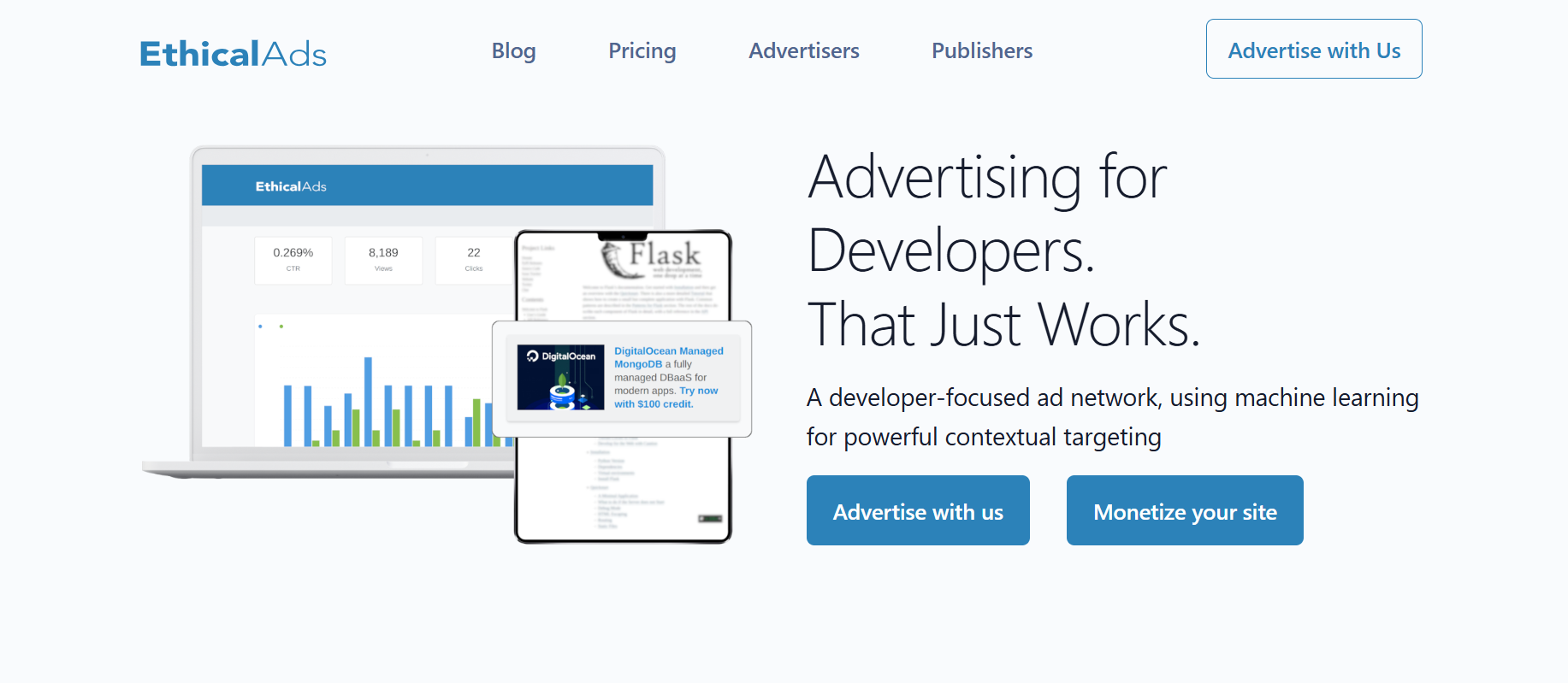
If your priority is privacy before maximum programmatic scale, EthicalAds may be the strongest option in this list.
It is particularly suitable for developer, open-source, technical, data-science, cybersecurity and software-related publishers.
EthicalAds describes its technology as privacy-first and focused on content targeting without invasive tracking.
EthicalAds Overview
- Best For: Developer and technical publishers
- Revenue Model: CPM advertising
- Cookie Duration: Not applicable
- Minimum Payout: $50
- Payment Frequency: Monthly
- Payment Methods: PayPal, Open Collective, GitHub Sponsors and bank transfer through Stripe Connect
- Traffic Preference: Approximately 50,000+ monthly pageviews for publisher applications
- Supported Niches: Developer-focused content
- Privacy Position: Excellent
EthicalAds states that publishers commonly see approximately $2.50 per 1,000 pageviews when much of their audience is located in the United States and Europe, although actual earnings vary.
Key Features
- No invasive behavioral targeting
- Context-based advertising
- Developer-oriented advertiser base
- Open-source orientation
- Simple advertising experience
- Publisher-friendly payment threshold
- Monthly payments
Pros
- One of the strongest privacy philosophies in this comparison
- Clear public payout threshold
- Highly relevant ads for developer audiences
- Less invasive user experience
- Transparent publisher requirements
Cons
- Narrow publisher niche
- Smaller advertising marketplace than Google
- Not suitable for many mainstream lifestyle websites
- Traffic requirements can exclude new publishers
Why Choose EthicalAds?
Choose EthicalAds when reader trust and privacy are major elements of your brand.
It is especially compelling for:
- programming blogs;
- open-source documentation;
- developer tools;
- data-science websites;
- cybersecurity resources;
- technical newsletters.
Who Should Avoid It?
Fashion, celebrity, general entertainment, recipes and unrelated mass-market publishers are unlikely to be ideal fits.
Expert Review
EthicalAds is the strongest recommendation in this article for publishers who interpret “respect privacy” very strictly.
Its only reason for ranking below the top three is scale and niche applicability.
Privacy Rating: 5/5
Overall Rating: 4.7/5
5. Google AdSense — Best Accessible Contextual Option
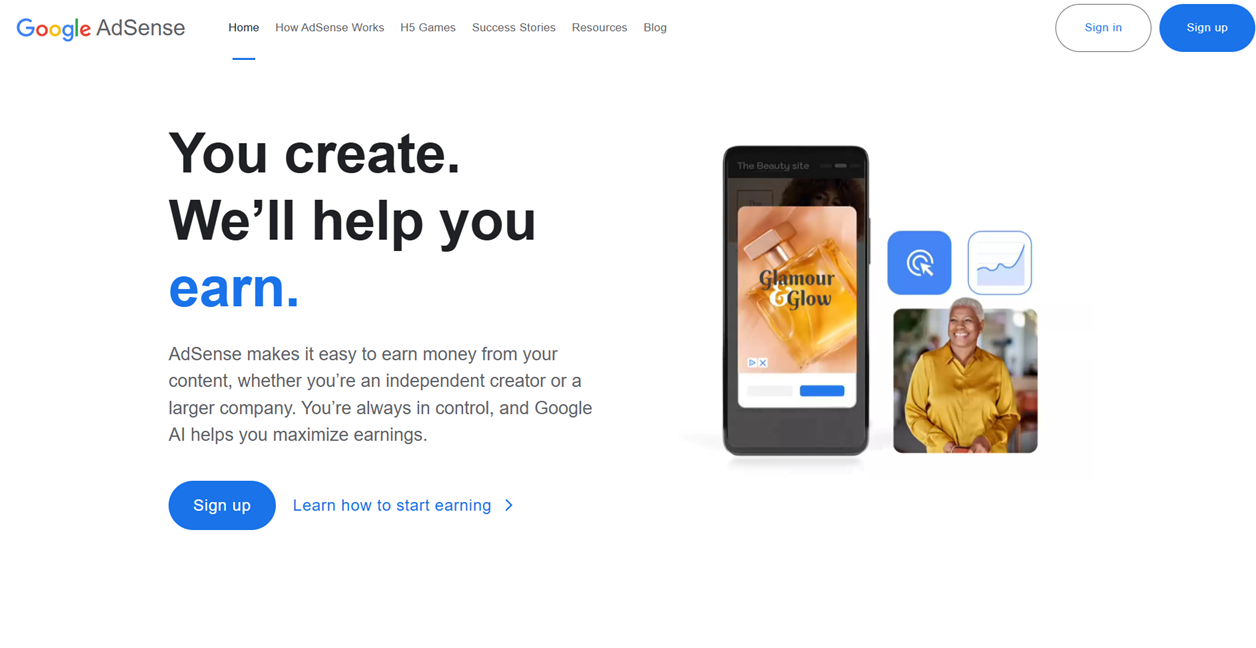
Google AdSense deserves inclusion because publishers can use non-personalized advertising that relies on contextual information rather than past user behavior.
Google states that non-personalized ads can use current site/app content, query terms and coarse geographic signals while excluding data used for personalized targeting.
However, AdSense should not be described as inherently privacy-first by default.
Google states that standard ad requests may use personalized advertising unless publishers implement appropriate privacy settings.
Google AdSense Overview
- Founded: Google launched AdSense in 2003
- Best For: Small and medium publishers
- Revenue Models: CPC/CPM and auction-based advertising
- Minimum Payout: Varies by payment currency/account settings
- Payment Frequency: Monthly after threshold and eligibility requirements
- Approval: Website/account review
- Supported Countries: Extensive global coverage
- Privacy Position: Configurable
- Contextual Capability: Strong
How AdSense Contextual Targeting Works
Google says its contextual technology analyzes factors including:
- keywords;
- word frequency;
- font prominence;
- page structure;
- overall web relationships.
It then uses those signals to understand the page and match advertising to it.
Pros
- Massive advertiser demand
- Accessible to smaller publishers
- Automated contextual matching
- Non-personalized ad controls
- Global reach
- Extensive reporting
- Multiple formats
Cons
- Default Google advertising ecosystem is not purely contextual
- Non-personalized ads can still use cookies for functions such as frequency capping/reporting
- Publishers remain responsible for privacy compliance
- Strict policy enforcement
Important Privacy Warning
Do not write:
“Google non-personalized ads use no cookies.”
Google explicitly states otherwise.
Non-personalized targeting does not use cookies or mobile identifiers to personalize advertising, but those technologies can still support measurement, frequency capping and related functionality.
Why Choose AdSense?
Choose AdSense when you need:
- relatively easy access;
- huge advertiser demand;
- contextual matching;
- global support;
- privacy configuration flexibility.
Expert Review
AdSense is probably the most practical starting point in this list for smaller websites.
Its ranking is lower because privacy requires deliberate configuration rather than being the platform’s only operating model.
Final Rating: 4.5/5
6. Snigel — Best Managed Contextual Monetization Partner
Snigel is a strong choice for publishers who want a managed monetization partner while retaining access to contextual advertising.
Snigel describes contextual advertising as a privacy-friendly alternative that targets ads using what the visitor is currently consuming rather than past browsing behavior.
Best For
- Growing publishers
- Established content websites
- Publishers wanting managed ad operations
- Sites seeking optimization beyond a single network
Key Features
- Contextual advertising
- Managed monetization
- Programmatic demand
- Revenue optimization
- Publisher support
- Ad-layout optimization
- Multiple formats
Pros
- Contextual monetization capability
- Managed support
- Broader revenue optimization
- Privacy-aware positioning
Cons
- Broader programmatic stack is not necessarily contextual-only
- Publisher eligibility applies
- Commercial terms vary by contract
Expert Review
Snigel’s biggest advantage is combining contextual advertising with hands-on monetization management.
Final Rating: 4.5/5
7. Outbrain — Best for Contextual Native Advertising

Outbrain is one of the strongest platforms for publishers interested in native contextual advertising and content discovery.
The company describes contextual targeting as targeting through contextual signals instead of third-party data.
Best For
- News publishers
- Editorial sites
- Large content platforms
- Native advertising inventory
- Publishers with high engagement
Key Features
- Native advertising
- Contextual targeting
- AI optimization
- Publisher integrations
- Semantic relevance
- Content recommendations
- First-party data capabilities
Outbrain also describes itself as contextual “by design” while simultaneously supporting first-party data and other advertising technologies.
Pros
- Excellent native formats
- Strong publisher relationships
- Mature contextual technology
- Large advertiser ecosystem
- Strong editorial compatibility
Cons
- Not a pure no-data advertising system
- Better suited to established publishers
- Native ad quality requires careful controls
Who Should Choose Outbrain?
Publishers with editorial inventory who want contextual/native monetization at scale should shortlist Outbrain.
Final Rating: 4.4/5
8. Taboola — Best for Contextual Content Discovery at Scale
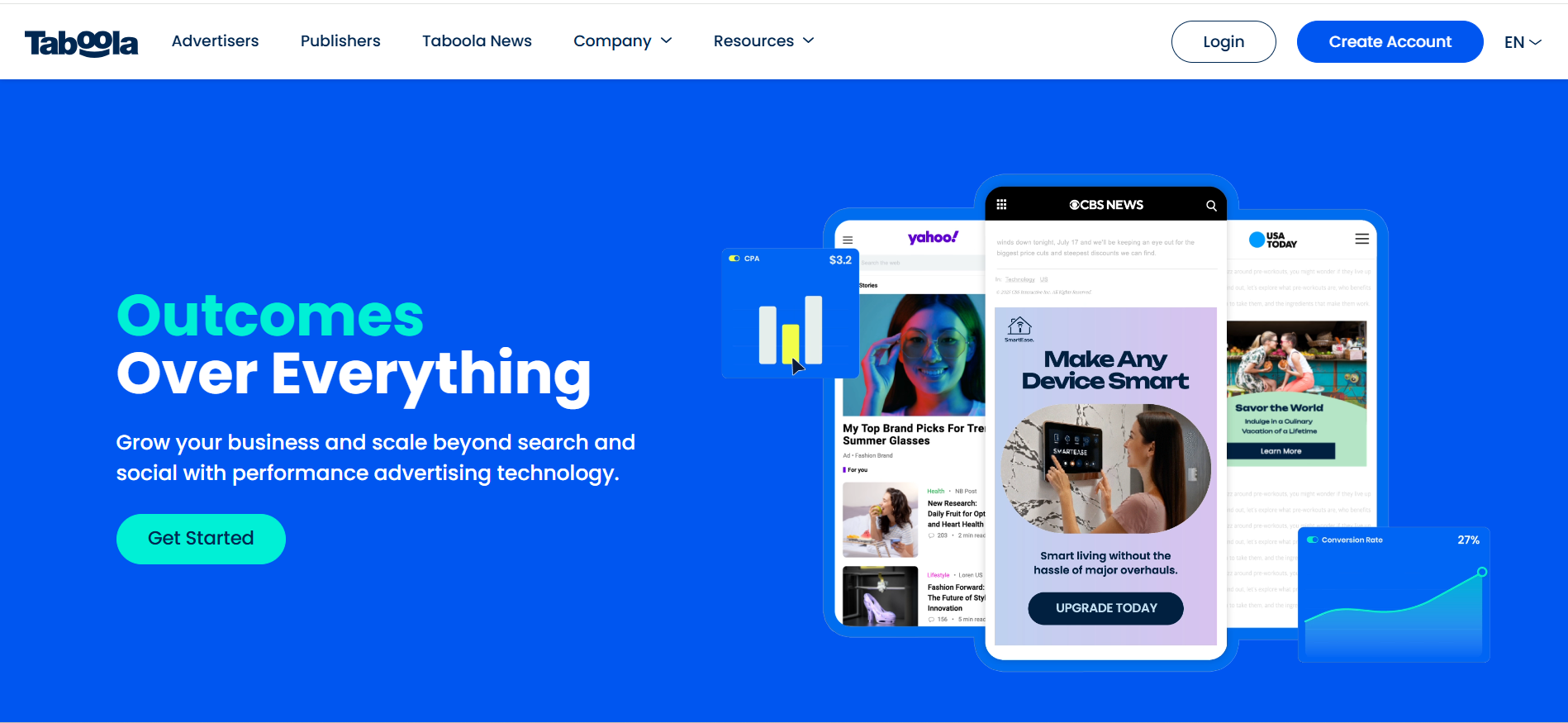
Taboola provides substantial publisher scale and offers contextual targeting using its content-classification technology.
Its documentation states that contextual targeting depends on its contextual classification algorithm and is not dependent on privacy-restricted personal targeting signals.
Best For
- News sites
- Editorial publishers
- Large content websites
- Native advertising
- Content discovery
Key Features
- Contextual classification
- Native advertising
- AI-based content understanding
- Publisher network
- Recommendation technology
- Topic targeting
- Conversion optimization
Privacy Considerations
Contextual targeting itself can operate without behavioral tracking.
However, Taboola’s broader product stack also includes first-party data, personalization and other optimization technologies.
Taboola itself explains that its publisher integrations can use first-party cookies for recommendation personalization while contextual targeting is available independently of third-party cookies.
Pros
- Massive scale
- Excellent native inventory
- Sophisticated AI
- Contextual targeting
- Premium publisher access
Cons
- Not a contextual-only ecosystem
- Native widgets require UX monitoring
- Publisher acceptance is selective
- Data practices vary according to products enabled
Expert Review
Taboola is excellent when publishers want scale.
It is not the correct choice when “privacy-friendly” is intended to mean “the advertising provider never performs any form of personalization.”
Final Rating: 4.4/5
9. Playwire — Best for Publishers Wanting Contextual + Full-Service Monetization
Playwire is better understood as a comprehensive publisher monetization company with contextual advertising capabilities rather than a pure contextual ad network.
Playwire identifies contextual advertising as increasingly valuable because it matches advertising with content without requiring behavioral targeting.
Best For
- Established publishers
- Gaming publishers
- Entertainment websites
- Publishers wanting managed monetization
Key Features
- Programmatic monetization
- Contextual advertising
- Direct advertiser relationships
- Publisher optimization
- First-party data strategy
- Video advertising
- Revenue management
Privacy Considerations
Playwire’s current data-processing terms illustrate why platform-level distinctions matter. The company supports contextual advertising but can also support targeted advertising and other processing where allowed and appropriately governed. Its agreement restricts interest-based advertising and identity-related processing for child-directed inventory while permitting contextual advertising.
Pros
- Full-service publisher strategy
- Contextual capability
- Strong monetization infrastructure
- Useful for sophisticated publishers
Cons
- Not contextual-only
- Selective onboarding
- More complex than plug-and-play networks
Final Rating: 4.3/5
10. Illuma — Best Contextual Intelligence Technology

Illuma is one of the most interesting contextual technology companies for publishers and advertisers interested in privacy-conscious contextual intelligence.
Its publisher platform analyzes:
- emotion;
- sentiment;
- keywords;
- metadata;
- live content signals.
Illuma says this approach enables publishers to extend reach and revenue while protecting privacy.
Best For
- Premium publishers
- Ad-tech teams
- Publishers selling direct campaigns
- Programmatic contextual optimization
- CTV
Key Features
- Contextual AI
- Sentiment analysis
- Content categorization
- Contextual recommendation
- Campaign expansion
- Display
- CTV
Pros
- Sophisticated contextual analysis
- Privacy-centric positioning
- Strong publisher use cases
- Advanced semantic technology
Cons
- Less suitable as a basic “paste this code into my WordPress blog” solution
- Enterprise-oriented
- Commercial details generally require consultation
Expert Review
Illuma earns the final Top 10 spot because it represents where contextual advertising is moving: away from primitive keyword matching and toward real-time machine understanding.
Final Rating: 4.3/5
More Contextual Advertising Platforms Worth Considering
The following companies are relevant to publisher monetization but need more qualification before being described as privacy-first contextual networks.
11. Setupad
Setupad provides header bidding and yield-management infrastructure for publishers.
It participates in the IAB Europe Transparency & Consent Framework and publicly identifies its CMP and vendor participation.
Best For
Established publishers wanting managed header bidding.
Strengths
- Multiple SSP connections
- Header bidding
- Yield optimization
- Consent infrastructure
- International operation
Privacy Caveat
Setupad is a broader programmatic monetization platform rather than a contextual-only network.
Rating: 4.1/5
12. Ezoic
Ezoic is a website monetization platform combining advertising, optimization, analytics and identity technology.
Its current advertising offering includes what Ezoic describes as a privacy-first identity layer, ezID.
Best For
Small-to-medium publishers seeking automated monetization.
Strengths
- Multiple advertising formats
- Analytics
- Ad-layout testing
- Automated optimization
- Lower barriers than some premium networks
Privacy Caveat
Ezoic should not be classified as a pure contextual network simply because privacy-oriented products exist.
Rating: 4.0/5
13. Mediavine

Mediavine is one of the best-known premium publisher monetization companies, particularly for independent lifestyle publishers.
Its privacy center supports regional privacy controls and explicitly provides settings for managing interest-based advertising.
That is a useful feature, but it also demonstrates why Mediavine should not be described as a contextual-only advertising network.
Best For
High-quality independent publishers.
Strengths
- Premium demand
- Publisher support
- Strong reputation in independent publishing
- Brand safety
- Privacy controls
Contextual/Privacy Fit
Moderate
Rating: 4.2/5
14. Raptive

Raptive is a major managed monetization platform for established publishers.
It is relevant when evaluating privacy-conscious publisher advertising ecosystems, but publishers should examine its current advertising, consent, identity and contextual implementations rather than assuming that all inventory is served contextually.
Best For
High-traffic independent publishers.
Strengths
- Premium demand
- Publisher services
- Advanced monetization
- Strong creator ecosystem
Main Limitation
Selective eligibility.
Rating: 4.2/5
15. Freestar

Freestar provides managed programmatic monetization and direct publisher marketplace capabilities.
Its Publisher Direct Marketplace currently uses first-party data for real-time targeting and connects publisher inventory to direct and programmatic demand.
Best For
Medium-to-large publishers.
Important Privacy Distinction
First-party targeting and contextual targeting are not the same thing.
A publisher wanting strict contextual-only monetization needs to investigate the exact deal configuration.
Rating: 4.0/5
16. Monumetric

Monumetric provides managed ad monetization for publishers.
However, it should not be called a privacy-first contextual advertising company without qualification.
Monumetric’s own advertising privacy documentation says its advertising partners can use cookies to support interest-based advertising and may track browsing behavior across websites.
Best For
Publishers prioritizing monetization management.
Privacy Rating
Lower than the leading companies in this guide.
Overall Rating: 3.8/5
17. AdPushup
AdPushup provides revenue optimization, header bidding and publisher ad technology.
Its own contextual-advertising guide highlights Media.net and other contextual solutions as privacy-oriented alternatives to behavioral targeting.
Best For
Publishers needing monetization optimization rather than a dedicated contextual network.
Strengths
- Ad optimization
- Header bidding
- Revenue experimentation
- Publisher technology
Main Limitation
AdPushup itself should be evaluated as a monetization technology provider rather than a pure contextual marketplace.
Rating: 3.9/5
18. Sovrn
Sovrn offers advertising, commerce and publisher monetization products.
Its current privacy policy makes clear that portions of the advertising ecosystem can include interest-based advertising and the construction of browsing-interest audience segments.
For that reason, it ranks below platforms fundamentally centered on contextual privacy.
Best For
Publishers wanting multiple monetization products.
Strengths
- Advertising
- Commerce
- Affiliate technology
- Publisher tools
- Programmatic demand
Privacy Fit
Moderate rather than strict.
Rating: 3.8/5
19. TripleLift

TripleLift operates advertising marketplace and creative technology across formats including native, display and video.
It can participate in privacy-oriented contextual strategies, but it functions as a broader programmatic advertising company rather than a privacy-only contextual network.
Best For
Premium publishers and programmatic monetization.
Rating: 3.9/5
20. Infolinks

Infolinks has historically specialized in advertising formats that interpret publisher content to create contextually relevant advertising opportunities.
Best For
Publishers seeking alternatives to conventional display placements.
Strengths
- In-text concepts
- Contextual relevance
- Additional monetization inventory
- Relatively simple integration
Limitations
- Revenue quality varies significantly by geography and vertical
- Not as technically advanced as modern semantic/contextual AI leaders
- Publishers should verify current payment and privacy terms before integration
Rating: 3.8/5
Contextual Ad Network Feature Comparison
Platform |
Core Contextual Focus |
Managed Service |
AI Contextual Analysis |
Native Ads |
Best Publisher Size |
| Seedtag | Excellent | Yes | Excellent | Yes | Medium–Enterprise |
| GumGum | Excellent | Yes | Excellent | Yes | Medium–Enterprise |
| Media.net | Excellent | Some | Strong | Yes | Small–Enterprise |
| EthicalAds | Excellent | Limited | Content-focused | Yes | Niche/Medium |
| Google AdSense | Strong | No | Strong | Yes | Small–Large |
| Snigel | Strong | Yes | Strong | Yes | Medium–Large |
| Outbrain | Strong | Yes | Strong | Excellent | Large |
| Taboola | Strong | Yes | Strong | Excellent | Large |
| Playwire | Strong | Excellent | Strong | Yes | Medium–Large |
| Illuma | Excellent | Enterprise | Excellent | Platform dependent | Enterprise |
Privacy Comparison
Platform |
Contextual Without User-History Targeting |
Broader Behavioral/Identity Products May Exist |
Privacy Assessment |
| EthicalAds | Yes | Minimal/core model avoids invasive tracking | Excellent |
| Seedtag | Yes | Other processing may occur depending on service | Excellent |
| GumGum | Yes | Broader advertising technology exists | Excellent |
| Illuma | Yes | Platform dependent | Excellent |
| Media.net | Yes | Yes | Strong |
| Google AdSense NPA | Yes | Yes | Strong when configured |
| Snigel | Yes | Yes | Strong |
| Outbrain | Yes | Yes | Strong |
| Taboola | Yes | Yes | Strong contextual mode |
| Playwire | Yes | Yes | Strong contextual mode |
| Monumetric | Not contextual-only | Yes | Moderate |
Publisher Payment Comparison
Payment structures for managed advertising companies differ considerably from affiliate networks.
Network |
Public Minimum Payout |
Payment Frequency |
| EthicalAds | $50 | Monthly |
| Google AdSense | Currency/account dependent | Monthly after threshold |
| Seedtag | Contract dependent | Contract dependent |
| GumGum | Contract dependent | Contract dependent |
| Media.net | Verify current account terms | Contract/account dependent |
| Snigel | Contract dependent | Contract dependent |
| Outbrain | Publisher contract | Contract dependent |
| Taboola | Publisher contract | Contract dependent |
| Playwire | Publisher contract | Contract dependent |
| Illuma | Commercial agreement | Commercial agreement |
Why aren’t we listing a number for every network?
Because inventing a standardized payout simply to complete a comparison table would make this article less trustworthy.
Large managed advertising platforms frequently negotiate terms according to:
- publisher size;
- country;
- inventory;
- advertiser agreements;
- payment currency;
- contract;
- ad formats.
Always verify your actual publisher agreement before switching networks.
Which Contextual Ad Network Is Best for Your Website?
Choose EthicalAds if:
You operate a developer or technology website and reader privacy is your highest priority.
Choose Seedtag if:
You operate premium editorial inventory and want sophisticated contextual AI.
Choose GumGum if:
You care about multimodal content analysis and advanced brand suitability.
Choose Media.net if:
You want a well-established contextual advertising platform with broader accessibility.
Choose Google AdSense if:
Your website is relatively new or you want a simple way to begin experimenting with contextual/non-personalized advertising.
Choose Snigel if:
You prefer managed monetization.
Choose Outbrain or Taboola if:
You operate substantial editorial traffic and native discovery units make sense for your UX.
Choose Playwire if:
You need an entire monetization operation rather than one contextual demand source.
Choose Illuma if:
You operate at enterprise level and want advanced contextual intelligence for direct/programmatic campaigns.
How to Choose a Contextual Ad Network
1. Decide what “privacy-friendly” means to your company
This should come before RPM.
There are at least four levels.
Level 1: Contextual targeting available
The network can target using page content.
Level 2: Non-personalized advertising available
Publishers can disable behavioral personalization.
Level 3: Contextual-first
Most of the platform’s identity and technology revolve around contextual advertising.
Level 4: Strict privacy-first
The network minimizes invasive tracking across its operating model.
These are not interchangeable.
2. Audit the Platform’s Actual Data Practices
Ask:
- Does it set cookies?
- Why?
- Does it track visitors across domains?
- Does it construct interest profiles?
- Does it process IP addresses?
- Does it use first-party identifiers?
- Does it participate in RTB?
- Does it support behavioral advertising?
- Can personalization be disabled?
- Does disabling personalization disable user-history targeting?
- What measurement technologies remain active?
3. Compare Revenue Models
Publisher advertising revenue can include:
CPM
Payment based on impressions.
CPC
Payment based on advertisement clicks.
Viewable CPM
Payment influenced by viewable impressions.
Programmatic auction revenue
Advertisers bid dynamically for inventory.
Private marketplace deals
Advertisers obtain premium publisher inventory through negotiated programmatic arrangements.
Direct contextual deals
Brands purchase inventory around specific topics or editorial environments.
These are fundamentally different from affiliate marketing.
There is normally no “30-day cookie commission” because a publisher is selling advertising inventory, not earning a percentage from an affiliate conversion.
4. Evaluate Contextual Technology
Avoid networks that describe basic keyword matching as advanced contextual AI.
Modern systems may evaluate:
- topics;
- intent;
- semantic relationships;
- sentiment;
- entities;
- images;
- videos;
- brand suitability;
- emotional context.
For example, GumGum’s technology has historically analyzed both text and imagery, while Seedtag’s current Liz technology incorporates contextual and intent-related signals.
5. Measure Revenue Per Thousand Sessions, Not Just CPM
A high CPM does not automatically mean a better monetization partner.
Use:
Page RPM = Revenue ÷ Pageviews × 1,000
Also analyze:
- session RPM;
- viewability;
- fill rate;
- advertisements per page;
- Core Web Vitals;
- engagement;
- bounce rate;
- ad-block rate.
A network producing a $15 CPM on 30% of impressions may generate less total revenue than one producing $8 with strong demand and fill.
6. Evaluate UX Costs
Advertising revenue can hurt long-term publisher value when monetization destroys the reading experience.
Measure:
- CLS;
- LCP;
- INP;
- intrusive interstitials;
- autoplay video;
- ad density;
- layout shift;
- cumulative ad load;
- navigation interruption.
The best ad network is therefore not necessarily the one with the highest theoretical RPM.
It is the one that maximizes:
Long-Term Publisher Value = Advertising Revenue + Audience Retention + Search Performance + Brand Trust
Common Mistakes Publishers Make With Contextual Advertising
Mistake #1: Assuming contextual means cookie-free
It doesn’t necessarily.
Google’s non-personalized ads illustrate this clearly: behavioral information is not used for ad selection, but cookies can still support measurement and frequency management.
Mistake #2: Confusing first-party advertising with contextual advertising
First-party data can still describe a person.
Contextual targeting describes the environment.
They solve different problems.
Mistake #3: Optimizing only for RPM
High ad density can:
- reduce engagement;
- damage UX;
- hurt page performance;
- increase bounce;
- weaken trust.
Mistake #4: Ignoring consent requirements
Privacy-friendly targeting does not remove all legal obligations.
The ICO specifically notes that storage and access technologies used for advertising can still require consent even where contextual advertising is used.
Consult appropriate privacy professionals for requirements applying to your markets.
Mistake #5: Using One Network Forever
Publishers should periodically test:
- RPM;
- fill rate;
- viewability;
- UX;
- geographic performance;
- advertiser quality.
The advertising market changes constantly.
Expert Tips for Maximizing Contextual Ad Revenue
Build strong topical clusters
Contextual systems work best when machines can clearly determine what a page is about.
A site with strong topical architecture provides better contextual signals than a site mixing unrelated subjects on every URL.
Keep individual pages semantically focused
Compare:
Weak contextual page
“Everything I Bought This Month”
versus:
Strong contextual page
“Best Trail Running Shoes for Rocky Terrain”
The second page provides stronger:
- product entities;
- commercial intent;
- categories;
- contextual signals.
Use descriptive titles and headings
Contextual systems can extract meaning from:
- H1s;
- subheadings;
- main copy;
- metadata;
- structured data;
- images.
Clear information architecture benefits both search engines and advertising systems.
Contextual Advertising and SEO
Contextual advertising does not directly improve Google rankings simply because ads are relevant.
However, a good contextual advertising implementation can indirectly support publishing quality by reducing irrelevant and invasive advertising.
Publishers should monitor:
- Core Web Vitals;
- ad layout shift;
- intrusive interstitials;
- page speed;
- mobile UX;
- content-to-ad ratio.
Do not let monetization overwhelm the reason the user visited the page.
Contextual Advertising and AI
The next major change is not simply “cookieless advertising.”
It is machine-understood context.
Traditional systems asked:
Which keywords are on this page?
Modern systems increasingly ask:
What does this page mean?
That requires:
- natural-language processing;
- embeddings;
- entity recognition;
- sentiment;
- image recognition;
- multimodal analysis;
- intent classification.
Seedtag now describes its technology in terms of Neuro-Contextual AI, while GumGum has invested heavily in AI-based contextual understanding across media environments.
Future Trends in Contextual Advertising
1. Multimodal contextual understanding
Advertising systems will increasingly interpret:
- copy;
- pictures;
- videos;
- audio;
- metadata
together.
2. Intent-level contextual targeting
“Cars” is a topic.
“Comparing electric SUVs before purchasing” is an intent.
The latter is considerably more valuable.
3. Contextual + first-party data hybrids
Many publishers will combine contextual understanding with voluntarily collected first-party information.
This can increase monetization, although it should not be confused with pure contextual targeting.
4. Brand-suitability intelligence
Advertisers increasingly care about more than avoiding unsafe content.
They want environments aligned with:
- tone;
- sentiment;
- brand values;
- commercial intent;
- audience mindset.
5. Greater contextual CTV adoption
Contextual analysis is expanding from traditional webpages toward video and connected television environments.
6. AI-native advertising
A newer 2026 development involves advertising specifically designed to appear in content consumed by AI agents rather than traditional human pageviews.
Experiments are already emerging around publisher pages prepared for AI crawlers, although this creates significant transparency and editorial-integrity questions.
Publishers should approach this carefully.
Advertising intended to influence AI-generated answers should be clearly labeled and separated from editorial claims.
Frequently Asked Questions
What is the best contextual ad network in 2026?
Seedtag is our strongest overall recommendation for established publishers because contextual intelligence and privacy-first advertising are central to its platform. EthicalAds is particularly strong for privacy-focused developer publishers, while Google AdSense remains more accessible to smaller sites.
Which contextual ad network respects privacy the most?
EthicalAds is one of the strongest choices for publishers seeking a deliberately privacy-first advertising model without invasive behavioral tracking.
Is Google AdSense contextual advertising?
Yes. Google AdSense uses contextual targeting among several targeting methods. Google analyzes page content to match relevant advertisements. Publishers can also request non-personalized ads.
Are Google non-personalized ads completely cookie-free?
No.
Google says its non-personalized advertising does not use cookies or mobile advertising identifiers for ad targeting, but those technologies may still be used for frequency capping, reporting and related functions.
Is contextual advertising GDPR compliant?
Contextual advertising can reduce privacy risk because ad selection does not need to depend on personal behavioral profiles.
However, publishers still need to comply with applicable data-protection and cookie/device-storage rules.
Contextual advertising is a targeting technique—not automatic legal compliance.
Does contextual advertising require cookies?
Not necessarily for targeting.
A system can match an advertisement with webpage content without identifying the visitor.
However, an advertising provider may still use cookies for:
- frequency capping;
- fraud prevention;
- analytics;
- attribution;
- reporting.
What is the difference between contextual and personalized advertising?
Contextual advertising decides which advertisement to show based primarily on what a person is currently viewing.
Personalized advertising uses information associated with that person or device, such as previous browsing behavior or inferred interests.
Does contextual advertising track users?
Pure contextual targeting does not require tracking users across websites.
However, individual contextual ad platforms may offer additional products that involve data collection.
Always evaluate the provider, not just the targeting label.
Is contextual advertising better than behavioral advertising?
It is better when privacy, contextual relevance and reduced cross-site tracking are priorities.
Behavioral targeting may remain valuable for retargeting or audience personalization.
The best approach depends on business objectives and privacy requirements.
What is semantic contextual advertising?
Semantic contextual advertising uses machine learning and NLP to interpret the meaning of a page rather than matching only literal keywords.
For example, it can distinguish:
- Apple the company;
- apple the fruit.
Which contextual network is best for bloggers?
Google AdSense and Media.net are more practical starting points for many bloggers because enterprise contextual platforms can have stricter publisher requirements.
Which contextual network is best for developers?
EthicalAds is particularly well suited to developer, programming, open-source, security and data-science audiences.
Which contextual ad network is best for premium publishers?
Seedtag and GumGum are excellent candidates for premium publishers seeking sophisticated contextual intelligence.
Which contextual platform is best for native ads?
Outbrain and Taboola are among the strongest choices for large-scale native advertising and content-discovery environments.
Can contextual ads pay as much as personalized ads?
Sometimes.
Revenue depends on:
- advertiser demand;
- geography;
- vertical;
- page intent;
- ad format;
- viewability;
- seasonality;
- inventory quality.
Highly valuable contextual environments can command strong advertiser demand.
Are contextual ads good for affiliate websites?
Yes.
Affiliate websites frequently publish highly commercial content such as:
- reviews;
- comparisons;
- buying guides;
- tutorials.
Those pages provide rich contextual signals.
However, publishers should avoid excessive advertising that cannibalizes affiliate clicks.
Can I combine contextual ads with affiliate marketing?
Yes.
A publisher can monetize one page using:
- contextual display advertising;
- native ads;
- affiliate links;
- sponsored content.
Test revenue per visitor rather than optimizing each channel independently.
Are contextual ads good for privacy-focused websites?
They are generally much better aligned with a privacy-focused strategy than cross-site behavioral profiling.
For strict privacy standards, choose a provider whose entire architecture matches your requirements.
Can contextual advertising improve user experience?
Potentially.
An advertisement for accounting software on an accounting tutorial is usually less jarring than an unrelated retargeting advertisement based on something the visitor viewed days earlier.
Poor ad density can still damage UX regardless of targeting method.
What traffic do I need for a contextual ad network?
Requirements vary.
Self-service platforms can accept smaller publishers, while premium contextual advertising partners may require significant traffic, strong editorial quality or direct commercial relationships.
EthicalAds, for example, currently indicates that it is looking for developer-focused sites with roughly 50,000+ monthly pageviews.
How do contextual ad networks know what my article is about?
They can analyze:
- keywords;
- headings;
- page text;
- entities;
- metadata;
- images;
- categories;
- sentiment;
- semantic relationships.
Advanced systems use NLP and machine learning rather than simple keyword matching.
What is the future of contextual advertising?
The industry is moving toward AI-powered semantic and multimodal contextual analysis capable of understanding not only the subject of content but also intent, sentiment, imagery, suitability and reader mindset.
Best Contextual Ad Network by Use Case
Use Case |
Recommended Platform |
| Best Overall | Seedtag |
| Best Contextual AI | GumGum |
| Best Traditional Contextual Network | Media.net |
| Best for Strict Privacy | EthicalAds |
| Best for Beginners | Google AdSense |
| Best Managed Monetization | Snigel |
| Best Native Advertising | Outbrain |
| Best Native Scale | Taboola |
| Best Full-Service Publisher Partner | Playwire |
| Best Contextual Intelligence Technology | Illuma |
| Best Developer Publishers | EthicalAds |
| Best Premium Publisher | Seedtag |
| Best Easy Starting Point | Google AdSense |
Final Verdict
The best contextual ad network is not simply the network promising the highest CPM.
In 2026, publishers should evaluate four things together:
revenue, context, privacy and user experience.
For premium publishers, Seedtag offers one of the strongest combinations of contextual intelligence and privacy-oriented advertising.
For sophisticated multimodal contextual technology, GumGum is an excellent contender.
For traditional contextual advertising at scale, Media.net remains highly relevant.
For publishers that place privacy above programmatic scale, EthicalAds stands out.
For smaller publishers needing easy access and enormous demand, Google AdSense, configured with appropriate privacy controls, remains extremely practical.
The most important principle is this:
Do not assume a company is privacy-first simply because it offers contextual targeting.
Some of the world’s largest advertising platforms now combine contextual targeting with:
- behavioral targeting;
- first-party data;
- identity products;
- predictive targeting;
- personalized advertising.
Those technologies can coexist.
Publishers therefore need to decide exactly where they want to sit on the spectrum between maximum targeting and minimum tracking.
Read More:
Best Ad Networks For Publishers
Best Google AdSense Alternatives
Best CPM Ad Networks For Publishers
Key Takeaways
- Contextual advertising targets the environment rather than primarily reconstructing a person’s historical browsing profile.
- Seedtag is our best overall contextual platform for premium publishers.
- GumGum is particularly strong for sophisticated contextual AI.
- EthicalAds is one of the strongest privacy-first choices.
- Media.net provides mature contextual advertising at broad scale.
- Google AdSense supports contextual and non-personalized advertising, but privacy controls must be configured appropriately.
- Outbrain and Taboola are strong for contextual native advertising.
- “Contextual,” “cookieless,” “first-party” and “privacy-first” do not mean the same thing.
- Contextual advertising can still involve cookies used for measurement or operational purposes.
- Publishers should evaluate revenue alongside page speed, UX and long-term reader trust.
- AI is moving contextual advertising from keyword matching toward semantic, emotional and multimodal content understanding.
Conclusion
Contextual advertising is no longer the primitive keyword-matching system publishers used two decades ago.
In 2026, advanced contextual platforms can understand topics, entities, intent, sentiment, images and the broader meaning of digital content.
That technological improvement is important because publishers no longer have to assume that better advertising relevance always requires deeper individual surveillance.
Seedtag, GumGum, Media.net, EthicalAds, Google AdSense, Snigel, Outbrain, Taboola, Playwire and Illuma demonstrate different approaches to solving that problem.
Some emphasize privacy.
Some emphasize scale.
Some emphasize AI.
Some emphasize managed monetization.
And some combine contextual advertising with much broader audience-targeting systems.
The best choice depends on your traffic, niche, privacy standards and monetization strategy.
For publishers building for the long term, the strongest approach is to treat privacy as part of advertising quality—not as a compliance checkbox added after monetization is already implemented.
