
The best HR software for sales automation in 2027 includes Rippling, BambooHR, Deel, Gusto, ADP Workforce Now, Paycom, Paylocity, UKG Pro, HiBob, and Personio. Among these, Rippling stands out as the best overall choice for growing sales organizations because it combines HR management, employee onboarding, payroll, performance management, compensation, integrations, and workflow automation in one connected platform. BambooHR is a strong choice for simplicity and growing teams, Deel is ideal for global sales organizations, and Gusto works particularly well for smaller U.S.-based companies.
Small sales teams rarely struggle with HR because their processes are inherently complicated—they struggle because too much work is still manual. Leave requests, onboarding, payroll questions, employee records, performance reviews, and compensation changes can quickly become dependent on emails, spreadsheets, and repetitive follow-ups. As a company grows from 50 employees to 200, 500, or even 1,000, those manual processes become increasingly difficult to manage, creating more opportunities for errors, delays, and administrative bottlenecks.
The right HR software helps solve this problem by turning repetitive HR tasks into structured, automated workflows. For sales organizations, that can mean faster onboarding for new representatives, easier performance management, streamlined compensation processes, centralized employee data, and better coordination between HR and sales operations. In this guide, we compare the 10 best HR software platforms for sales automation in 2027 to help you identify the right solution based on company size, sales-team needs, automation capabilities, global requirements, and long-term scalability.
What “HR Software for Sales Automation” Actually Means
HR software for sales automation is technology that automates the people-related processes behind a sales organization, including recruiting, onboarding, payroll, performance management, compensation, employee records, compliance, workforce analytics, and offboarding. It is different from sales automation software, which focuses on prospecting, outreach, CRM activity, pipeline management, and deal management.
This distinction is important because sales organizations can range from a small team of five to thousands of employees across multiple countries, with different roles, compensation plans, territories, and working arrangements. The right HR platform should therefore automate repetitive processes such as hiring, sales-rep onboarding, employee documentation, payroll, benefits, time tracking, performance reviews, goals, feedback, compensation planning, promotions, employee changes, offboarding, and HR-to-payroll or HR-to-CRM data synchronization.
Modern platforms increasingly connect these processes through a shared employee-data layer. Rippling stands out for connecting HR, payroll, performance, compensation, and workflow automation; BambooHR combines people data with hiring, payroll, performance, and compensation; while Deel takes a global-first approach by combining HR, payroll, hiring, performance, workforce planning, and compensation for international teams. Together, these capabilities help sales organizations reduce manual work and build a more scalable HR operation.
Why Sales Teams Need Different HR Software
Traditional HR software typically focuses on essential administrative tasks such as payroll accuracy, employee records, PTO, benefits, compliance, and onboarding. While these functions remain important, sales organizations have additional operational requirements that make their HR needs more specialized.
Sales teams also need to manage factors such as:
- Ramp time and quota attainment
- Territory and role assignments
- Promotion paths and career development
- Variable compensation and commissions
- Performance targets and coaching
- Sales onboarding and manager effectiveness
- Rep retention and productivity
- Headcount and workforce planning
- Performance-based compensation
This creates an important connection between HR data and revenue data. For example, when a new account executive joins a company, an automated HR workflow can connect the entire process:
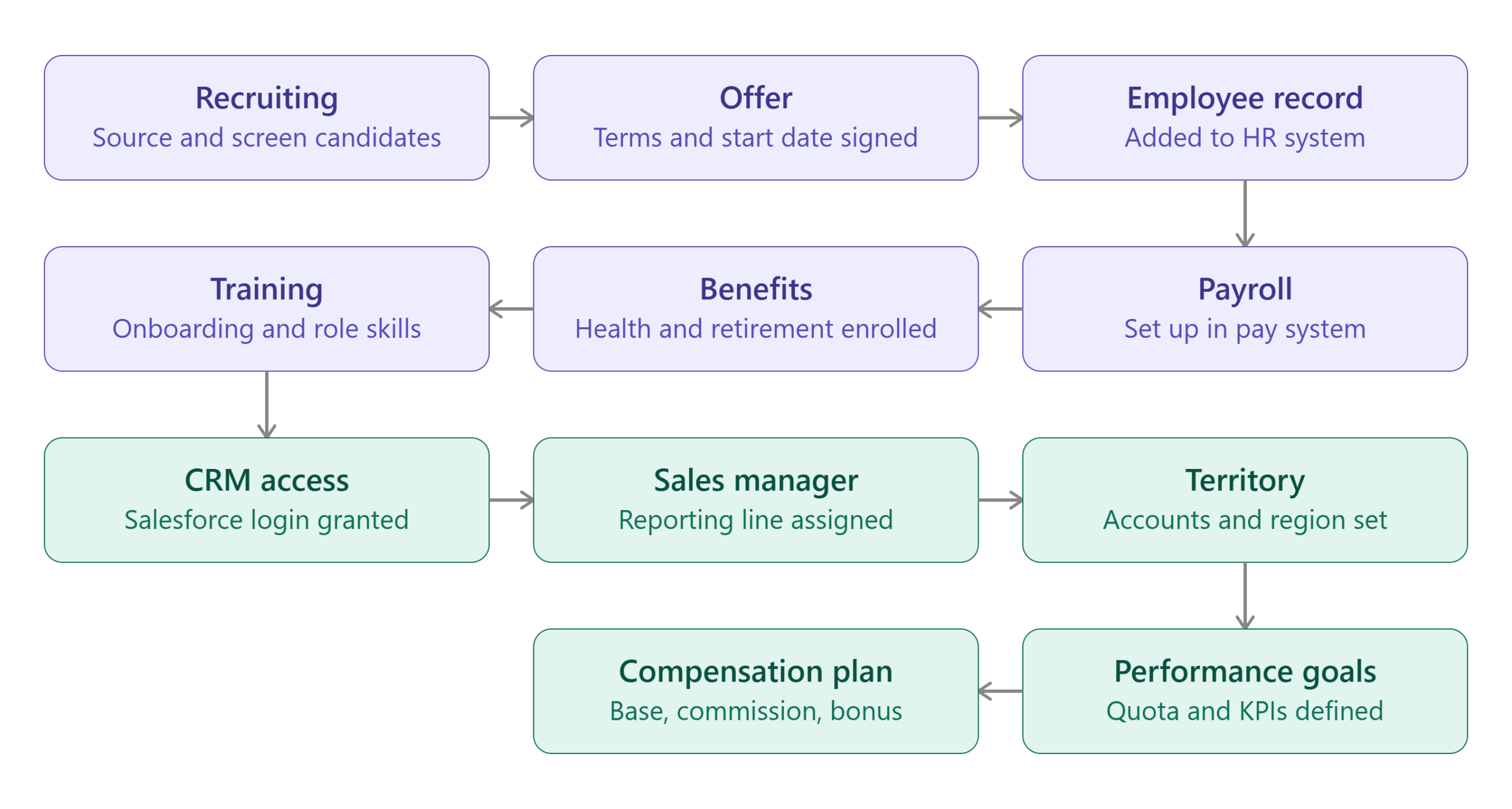
By connecting these steps, HR automation reduces manual work while helping sales teams onboard faster, manage performance more effectively, and scale operations with fewer administrative bottlenecks.
How We Evaluated these HR Softwares
This isn’t simply a list of the most recognizable HR software companies. We evaluated each platform based on how well it can support the real operational needs of modern sales organizations, from hiring and onboarding to performance management, compensation, payroll, and workforce planning. We also considered factors such as automation, ease of use, integrations, scalability, and global workforce support so the recommendations remain useful for both growing businesses and larger sales organizations.
The evaluation considered eight key dimensions:
1. Core HR Automation
We looked at how effectively each platform automates everyday HR tasks, including employee records, onboarding, leave management, payroll workflows, documentation, and other repetitive administrative processes.
2. Sales-Relevant Performance Management
Sales teams need more than annual employee reviews. We considered whether platforms support goals, performance reviews, feedback, 1:1s, coaching, development plans, and performance tracking that can align with sales targets.
3. Compensation
Compensation is particularly important for sales organizations. We assessed how well each platform manages salary changes, compensation planning, promotions, bonuses, and connections between performance and pay. Complex commission calculations may still require dedicated sales compensation software.
4. Employee Lifecycle
We evaluated whether a platform can support employees throughout their entire journey—from recruiting and hiring to onboarding, development, promotion, and offboarding—without forcing HR teams to manage every step manually.
5. Integrations
Modern sales organizations rely on multiple systems. We considered integrations with CRM platforms, payroll, accounting and finance tools, identity providers, collaboration software, and other business applications. Strong integrations can reduce duplicate data entry and keep employee information synchronized.
6. Global Capabilities
For companies with international sales teams, we examined support for global employees, contractors, payroll, benefits, compliance, and international hiring. Platforms such as Deel are particularly relevant when managing a distributed workforce across multiple countries.
7. Usability
Powerful features are only valuable when people can actually use them. We considered the overall user experience for HR teams, managers, employees, and sales leaders, including how easy it is to configure workflows, access information, and complete everyday tasks.
8. Scalability
Finally, we considered whether each platform can grow alongside the organization. A solution that works well for a 30-person sales team may not be suitable for a company with 500 or 5,000 employees. We therefore looked at functionality, automation, workforce complexity, reporting, and administrative requirements as organizations scale.
Together, these criteria allow us to evaluate HR platforms based on their practical value to sales organizations—not simply the number of features they advertise.
Best HR Softwares for Sales Automation in 2027
Here’s the list of the best HR Softwares for Sales Automation in 2027:
- Rippling — Best for overall HR and sales-team automation
- BambooHR — Best for growing sales teams and ease of use
- Deel — Best for global and distributed sales teams
- Gusto — Best for small U.S.-based sales teams
- ADP Workforce Now — Best for established mid-market sales organizations
- Paycom — Best for comprehensive employee lifecycle automation
- Paylocity — Best for performance-focused sales organizations
- UKG Pro — Best for enterprise sales teams and complex workforces
- HiBob (Bob) — Best for modern, international sales organizations
- Personio — Best for European and growing mid-market sales teams
1. Rippling
Company Overview
| Attribute | Details |
|---|---|
| Founded | 2016 |
| Headquarters | San Francisco, California |
| Best for | Growing and scaling companies |
| Ideal sales environment | SMB through enterprise |
| Editorial rating | 9.5/10 |
| Pricing | Custom |
Best overall HR software for sales automation in 2027. Rippling is the top choice for organizations that want to automate the entire operational layer around a sales team—not just manage employee records, but connect HR, IT, and workforce workflows into one unified system.
Rippling stands out for its ability to unify HR, payroll, benefits, recruiting, performance, compensation, and IT management into a single platform powered by shared employee data. For growing sales organizations, this means onboarding a new hire can automatically trigger everything from payroll setup and benefits enrollment to laptop provisioning, app access, and role-based permissions—all in one workflow.
By reducing manual coordination and keeping data consistent across systems, Rippling helps teams scale faster with fewer errors. While it is more HR-centric than a dedicated IT automation tool and pricing can increase as modules are added, it remains one of the most powerful all-in-one platforms for companies that want to centralize people and technology operations efficiently.
Key Features
- Unified HR + IT Platform — Manage HR, payroll, benefits, and IT operations from a single system with shared employee data
- End-to-End Employee Lifecycle Automation — Automates hiring, onboarding, promotions, role changes, and offboarding workflows
- All-in-One Onboarding — Set up payroll, benefits, apps, permissions, and devices in one seamless process
- Payroll & Global Workforce Management — Automates payroll, tax compliance, and supports global employees and contractors
- Performance & Compensation Management — Handles reviews, goals, feedback, compensation planning, and payroll synchronization
- Workflow Automation & Integrations — Custom workflows with triggers plus 600+ integrations for app provisioning and access control
Pros
- Excellent workflow automation
- Strong unified data architecture
- Performance and compensation integration
- Strong HR + IT combination
- Useful for distributed organizations
- Strong integrations
- Good fit for rapidly scaling companies
Cons
- Pricing isn’t fully transparent
- More platform than very small companies may need
Pricing
Rippling uses custom pricing. Its pricing documentation states that products are generally billed per employee per month, while some products can include a monthly base fee.
2. BambooHR
Company Overview
| Attribute | Details |
|---|---|
| Founded | 2008 |
| Headquarters | Lindon, Utah |
| Best for | Growing businesses |
| Ideal sales environment | SMB and mid-market |
| Editorial rating | 9.2/10 |
Best HR software for growing sales teams that prioritize usability and people operations. BambooHR is one of the most reliable choices for companies that need a strong HR foundation without jumping into the complexity of enterprise-level HCM systems.
BambooHR is designed for small to mid-sized organizations that want to simplify and automate core HR processes while maintaining an excellent user experience. It centralizes employee data and streamlines tasks like onboarding, offboarding, time-off management, e-signatures, and performance tracking through intuitive workflows that are easy for HR teams and employees to use.
Its standout strength is usability—employees can manage their own information through self-service portals, reducing administrative back-and-forth. While BambooHR excels at handling HR operations and people management, it is not built for IT automation such as device provisioning or app access, meaning companies may still need additional tools for those functions. Overall, it’s a clean, reliable, and scalable HR platform for growing sales teams.
Pros
- Excellent user experience
- Strong HR foundation
- Good performance capabilities
- Clear published pricing
- Strong reporting
- Good fit for growing businesses
Cons
- Advanced sales compensation may require another system
- Not primarily a sales-performance platform
Pricing
BambooHR currently lists U.S. Core at $10 per employee per month, Pro at $17, and Elite at $25 for companies above 25 employees. Companies with 25 or fewer employees have flat-rate pricing starting at $250/month.
3. Deel
Company Overview
| Attribute | Details |
|---|---|
| Founded | 2019 |
| Headquarters | San Francisco, California |
| Best for | International companies |
| Global focus | 150+ countries |
| Editorial rating | 9.1/10 |
Best HR software for global and distributed sales teams. Deel is a top choice for organizations hiring sales reps across multiple countries, offering a powerful combination of global HR, payroll, compliance, and workforce management in one platform.
Deel is built specifically for companies managing international teams, making it ideal for sales organizations with distributed account executives, SDRs, and managers. It combines Employer of Record (EOR) services, global payroll across 150+ countries, contractor management, and core HR into a single system centered around unified worker profiles.
This allows businesses to hire, pay, and manage employees or contractors without setting up local entities. In addition to core HR functions like time off and people analytics, Deel also offers modular features for recruiting, performance management, workforce planning, and even immigration support—making it a comprehensive solution for scaling global sales operations efficiently and compliantly.
Key Features
Pros
- Excellent global coverage
- Strong international compliance positioning
- HR + payroll integration
- Contractor support
- Hiring capabilities
- Compensation and performance capabilities
Cons
- More than a domestic SMB may need
- Costs vary considerably by workforce model
Pricing
Deel publishes several prices depending on the product. Its current pricing page lists talent sourcing from $14/worker/month, contractors at $49/contractor/month, and Contractor of Record at $325/contractor/month, while other employment services use different pricing structures.
4. Gusto
Company Overview
| Attribute | Details |
|---|---|
| Founded | 2011 |
| Headquarters | San Francisco, California, USA |
| Best For | Small businesses and startups |
| Ideal Sales Environment | Small to early-stage sales teams |
| Core Focus | Payroll, HR, benefits, and employee management |
Best for small U.S. sales teams that want straightforward HR and payroll automation. Gusto is an ideal choice for startups and small businesses that need simple, reliable HR processes without the complexity of enterprise-level systems.
Gusto is designed to automate essential HR tasks for small teams, making it especially useful for early-stage sales organizations. It simplifies payroll with automated tax filings, streamlines benefits enrollment, and provides onboarding checklists that help new hires get started quickly without requiring a dedicated HR team.
By putting payroll on autopilot and reducing manual admin work, Gusto allows founders and managers to focus more on growing their sales operations rather than managing HR processes. While it doesn’t offer the advanced capabilities of larger HCM platforms, it delivers exactly what small teams need—speed, simplicity, and reliability.
Key Features
- Automated Payroll & Tax Filing — Runs payroll on autopilot with automatic calculations, direct deposits, and multi-state tax compliance
- Benefits Administration & Payroll Sync — Manages employee benefits with seamless deduction syncing to payroll
- Onboarding & Hiring Workflows — Digital offer letters, e-signatures, and structured new-hire checklists for faster setup
- Time Tracking, PTO & Scheduling — Tracks work hours, manages paid time off, and supports employee scheduling
- Employee Self-Service Portal — Allows employees to access pay stubs, benefits, and personal information independently
- Workforce Analytics & Expense Management — Provides reporting, workforce costing insights, and expense tracking for better decision-making
Pros
- Easy to use
- Strong small-business payroll
- Transparent pricing
- Good onboarding
- Employee self-service
- Low operational complexity
Cons
- Less powerful for enterprise HR
- Limited advanced workforce planning
Pricing
Gusto’s current pricing page lists Simple at $49/month + $6/person, Plus at $80/month + $12/person, and Premium at $180/month + $22/person.
5. ADP Workforce Now
Company Overview
| Attribute | Details |
|---|---|
| Founded | 1949 |
| Headquarters | Roseland, New Jersey |
| Best for | SMB through enterprise |
| Editorial rating | 8.7/10 |
Best for established mid-market organizations that need mature payroll, HR, talent, and compensation capabilities. ADP Workforce Now is particularly well suited for companies with 50–1,000 employees that prioritize payroll accuracy and compliance across jurisdictions.
ADP Workforce Now is a comprehensive HCM platform built around strong payroll automation, making it a reliable choice for growing sales organizations that require stability and compliance. It combines HR, payroll, time tracking, benefits administration, and talent management into a single system, with compensation tools that connect directly to performance and payroll processes.
Its ability to handle scheduled payroll runs, tax filings, and multi-state compliance makes it especially valuable for U.S.-based mid-market companies. While it may not be as flexible or modern as newer platforms, ADP Workforce Now delivers proven reliability, depth, and scalability for organizations that need dependable HR infrastructure.
Key Features
- Payroll Automation & Compliance — Automated payroll processing with error detection, tax filing, and year-end reporting across jurisdictions
- Unified HR, Benefits & Time Management — Manage employee data, benefits, and time tracking within a single system of record
- Talent Acquisition & Workforce Management — Tools for recruiting, hiring, and managing workforce operations efficiently
- Performance & Compensation Management — Connects performance reviews with compensation planning, merit increases, and bonus cycles
- Benchmarking & Workforce Analytics — Provides reporting, analytics, and benchmarking insights for data-driven decision-making
- Integrated Talent & HR Suite — Combines payroll, benefits, time, and talent modules into one connected platform
Pros
- Mature ecosystem
- Strong payroll
- Large-scale support
- Compensation capabilities
- Workforce benchmarking
- Broad HR coverage
Cons
- Can be complex
- Pricing is quote-based
Pricing
- $10–$20+ per employee/month (core features)
- $100–$500+ monthly base fee depending on company size
6. Paycom
Company Overview
| Attribute | Details |
|---|---|
| Founded | 1998 |
| Headquarters | Oklahoma City, Oklahoma |
| Best for | Mid-market and enterprise |
| Editorial rating | 8.7/10 |
Best for organizations that want extensive employee-lifecycle automation through a unified HR platform. Paycom is ideal for companies looking to manage HR, payroll, and talent processes from a single, tightly integrated system.
Paycom is built around a single-database architecture that connects HR, payroll, time tracking, talent acquisition, and talent management into one unified platform. This structure allows organizations to automate the entire employee lifecycle—from hiring and onboarding to performance management and compensation—without data silos or duplication.
For sales organizations, this means more consistent employee data, fewer manual processes, and better alignment between HR operations and workforce performance. While it may require more upfront configuration compared to simpler tools, Paycom offers strong depth and control for companies that want comprehensive automation within one system.
Key Features
- Unified HR & Payroll Platform — Single database connecting HR, payroll, time, and talent data for consistency and accuracy
- Recruiting & Talent Acquisition — Tools to manage hiring pipelines, candidates, and onboarding workflows
- Time & Labor Management — Tracks employee hours, attendance, and labor costs in real time
- Performance & Talent Management — Supports performance reviews, training, and employee development programs
- Compensation & Merit Planning — Enables structured merit increases and compensation decisions tied to performance
- Employee Self-Service & Workflow Automation — Empowers employees to manage their own data while automating lifecycle workflows
Pros
- Strong lifecycle automation
- Unified database
- Extensive HCM capabilities
- Talent management
- Employee self-service
Cons
- Quote-based pricing
- More complex than small businesses need
Pricing
$20–$40+ per employee/month
7. Paylocity
Company Overview
| Detail | Information |
|---|---|
| Founded | 1997 |
| Country | United States |
| Software Type | HR, Payroll & Workforce Management Software (HCM) |
| Core Features | HR Management, Payroll, Talent Management, Recruitment, Onboarding, Time & Labor, Performance, Analytics |
| Deployment | Cloud-based |
| Pricing Model | Subscription / Per-employee (custom pricing) |
| Free Trial | Not publicly available |
| Starting Price | Custom pricing (typically mid-market pricing; not publicly disclosed) |
| Payment Frequency | Monthly / Annual contract |
| Supported Platforms | Web, iOS, Android |
Best for mid-market organizations that want performance management integrated with broader HR operations. Paylocity is a strong choice for companies that want to align employee performance with HR processes in a single platform.
Paylocity offers a well-rounded HCM platform that combines HR, payroll, time tracking, and talent management with a particular strength in performance management. Its system emphasizes continuous feedback, goal tracking, and employee development, making it especially useful for sales organizations that rely on ongoing performance improvement and coaching.
By integrating performance data with broader HR operations, Paylocity helps managers make more informed decisions around productivity, engagement, and workforce planning. While it may not be as globally focused as some competitors, it provides a balanced and scalable solution for mid-market teams looking to connect performance with day-to-day HR workflows.
Key Features
- Unified HR & Payroll Platform — Centralizes employee data, payroll processing, and benefits administration in one system
- Performance Management & Goal Tracking — Supports continuous feedback, goal setting, reviews, and employee development
- Workforce Management — Includes time tracking, scheduling, and labor cost management for operational efficiency
- Employee Experience Tools — Engagement features such as surveys, social collaboration, and communication tools
- Analytics & Reporting — Provides real-time insights into workforce performance, productivity, and HR metrics
- Talent & Development Tools — Enables coaching, career development, and performance-based growth planning
Pros
- Strong performance management
- Good mid-market fit
- Employee experience
- Goal management
- HR/payroll integration
Cons
- Quote-based pricing
- Less global-first than Deel
8. UKG Pro
Company Overview
| Detail | Information |
|---|---|
| Founded | 2020 (formed from the merger of Ultimate Software and Kronos) |
| Country | United States |
| Software Type | Enterprise HR, Payroll & Workforce Management Software (HCM) |
| Core Features | HR Management, Payroll, Talent Management, Recruiting, Onboarding, Time & Labor, Performance, Workforce Analytics |
| Deployment | Cloud-based |
| Pricing Model | Subscription / Per-employee (custom pricing) |
| Free Trial | Not publicly available |
| Starting Price | Custom pricing (enterprise-level; not publicly disclosed) |
| Payment Frequency | Annual / Contract-based |
| Supported Platforms | Web, iOS, Android |
Best for large organizations with complex workforce-management requirements. UKG Pro is particularly well suited for enterprises that need to manage scheduling, time, attendance, and workforce operations at scale.
UKG Pro is an enterprise-grade HCM platform that combines HR, payroll, talent management, and advanced workforce management into a single system. It excels at handling the operational complexity of large, shift-based workforces by automating scheduling, time tracking, and absence management while providing AI-driven workforce insights and reporting.
This makes it especially valuable for industries like healthcare, retail, and manufacturing where labor planning and compliance are critical. While it may be more robust than necessary for smaller teams, UKG Pro delivers the depth, scalability, and operational control required by large organizations with demanding workforce needs.
Key Features
- Enterprise HCM Platform — Unified system covering HR, payroll, talent management, and workforce operations
- Advanced Workforce Management — Scheduling, time tracking, attendance, and absence management for complex environments
- Rules-Based Scheduling & Overtime Alerts — Automates shift planning while ensuring compliance with labor rules and overtime policies
- Payroll & Compliance Management — Handles complex pay structures, regulatory compliance, and multi-jurisdiction payroll
- AI-Driven Insights (Bryte AI) — Provides predictive analytics and workforce insights for better decision-making
- Workforce Planning & Employee Communication — Supports strategic planning, employee engagement, and internal communication tools
Pros
- Enterprise capabilities
- Strong workforce management
- AI features
- Payroll
- Workforce analytics
- Global capabilities
Cons
- Overkill for small teams
- Implementation complexity
9. HiBob
Company Overview
| Detail | Information |
|---|---|
| Founded | 2015 |
| Country | United Kingdom (with offices in Israel and the United States) |
| Software Type | HR & People Management Software (HCM) |
| Core Features | HR Management, Onboarding, Performance, Compensation, Employee Engagement, Surveys, Time Off, Workforce Planning |
| Deployment | Cloud-based |
| Pricing Model | Subscription / Per-employee (custom pricing) |
| Free Trial | Not publicly available |
| Starting Price | Custom pricing (not publicly disclosed) |
| Payment Frequency | Annual / Contract-based |
| Supported Platforms | Web, iOS, Android |
Best for modern, international companies that prioritize employee experience alongside HR automation. HiBob is an excellent choice for growing and global organizations that want flexible, people-centric HR workflows without the complexity of enterprise systems.
HiBob (also known as Bob) is a modern HR platform designed for mid-sized and international companies that need more than basic HR tools but less complexity than enterprise HCM systems. Founded in 2015 by Ronni Zehavi, Israel David, Andy Bellass, and Amit Knaani, HiBob combines core HR with performance management, engagement, compensation, and workforce planning in a flexible system that adapts workflows based on role and location.
Its automation capabilities streamline onboarding, approvals, and document management, while its newer AI features provide natural language insights and enhanced employee self-service. By balancing automation with a strong focus on employee experience, HiBob helps organizations improve engagement, visibility, and operational efficiency as they scale globally.
Key Features
- Core HR & Workflow Automation — Manages employee data, approvals, document workflows, and e-signatures across the entire employee lifecycle
- Performance, Engagement & Feedback — Supports reviews, continuous feedback, surveys, and employee engagement initiatives
- Compensation & Workforce Planning — Enables compensation management, headcount planning, and organizational visibility
- Time Off & Attendance Management — Automates leave requests, tracking, and attendance-related workflows
- People Analytics & Reporting — Provides dashboards, insights, and reporting to support data-driven HR decisions
- AI-Powered Employee Experience — Enhances self-service, insights, and HR processes with AI-driven capabilities
Pros
- Modern UX
- Strong employee experience
- International orientation
- Performance and compensation
- Flexible modules
Cons
- Custom pricing
- Some capabilities require additional modules
10. Personio
Company Overview
| Detail | Information |
|---|---|
| Founded | 2015 |
| Country | Germany |
| Software Type | HR & Payroll Software (HCM) |
| Core Features | HR Management, Payroll, Recruiting, Onboarding, Time & Attendance, Performance, Compensation, Analytics |
| Deployment | Cloud-based |
| Pricing Model | Subscription / Per-employee (custom pricing) |
| Free Trial | Not publicly available |
| Starting Price | Custom pricing (not publicly disclosed) |
| Payment Frequency | Annual / Contract-based |
| Supported Platforms | Web, iOS, Android |
Best for European and international SMB/mid-market companies seeking structured HR workflows. Personio is a strong choice for organizations that want standardized, compliant HR processes with room to scale.
Personio is built to help growing companies centralize and automate their HR operations through structured workflows. It brings together employee profiles, document management, analytics, workflow automation, time tracking, and payroll preparation into a single system, making it easier to manage day-to-day HR tasks efficiently. Beyond core HR, Personio also offers modules for recruiting, compensation, and employee surveys, enabling companies to expand their HR capabilities as they grow.
A standout feature is Personio Conversations, an integrated HR help desk that centralizes employee requests and streamlines communication between staff and HR teams. Overall, Personio is ideal for organizations that need a reliable, process-driven HR platform to support scalable and compliant people operations.
Key Features
- Core HR & Employee Records — Centralizes employee data, documents, and lifecycle management in a structured system
- Workflow Automation & Case Management — Automates HR processes with dashboards to track, assign, and manage employee requests and workflows
- Recruiting & Workforce Planning — Built-in tools for hiring, headcount planning, and scaling teams efficiently
- Time Tracking & Payroll Preparation — Tracks attendance, working hours, and supports payroll workflows
- Compensation, Surveys & Employee Experience — Manages compensation processes and gathers employee feedback through surveys
- AI Assistant & Omnichannel Support — Provides real-time answers, analyzes HR trends, and integrates with tools like Slack and Microsoft Teams for seamless communication
Pros
- Strong European fit
- Good workflow automation
- Recruiting
- Compensation add-ons
- International orientation
Cons
- Pricing requires a quote
- Product configuration can become modular
Best HR Software for Sales Automation at a Glance
| Platform | Best for | Sales-relevant strength | Pricing approach | Editorial rating |
|---|---|---|---|---|
| Rippling | Overall | Automation + performance + compensation | Custom | 9.5/10 |
| BambooHR | Growing companies | Performance + HR simplicity | From $10/employee/month in U.S. Core | 9.2/10 |
| Deel | Global sales teams | International employment + HR | Mix of published and custom pricing | 9.1/10 |
| Gusto | Small U.S. teams | Payroll + HR + onboarding | From $49/month + $6/person | 8.8/10 |
| ADP Workforce Now | Mid-market | Payroll + talent + compensation | Custom | 8.7/10 |
| Paycom | Automation-focused HR | Unified employee lifecycle | Custom | 8.7/10 |
| Paylocity | Mid-market | Goals + performance + HR | Custom | 8.6/10 |
| UKG Pro | Enterprise | Workforce complexity | Custom | 8.6/10 |
| HiBob | Modern/global teams | Performance + employee experience | Custom | 8.5/10 |
| Personio | SMB/mid-market | HR workflows + recruiting | Custom | 8.4/10 |
What Software Should You Pair With HR Software?
CRM
A CRM manages:
- leads
- contacts
- accounts
- opportunities
- pipeline
- activities
- forecasts
- customer relationships
Examples include Salesforce and HubSpot.
Sales Engagement
Sales engagement tools automate:
- prospecting
- email sequences
- calls
- cadences
- follow-ups
- buyer engagement
Salesloft, for example, describes its platform as automating repetitive selling tasks while integrating with CRM systems.
Sales Performance Management
SPM platforms are designed around:
- quotas
- territories
- incentives
- commissions
- seller performance
- compensation planning
CaptivateIQ provides incentive compensation, quota and capacity planning, territory management and performance analytics.
Performio similarly focuses on complex commission calculations, incentive plans, quota-related performance and compensation reporting.
How to Choose the Right HR Software for a Sales Organization
Step 1: Map your employee lifecycle
Write down every stage:
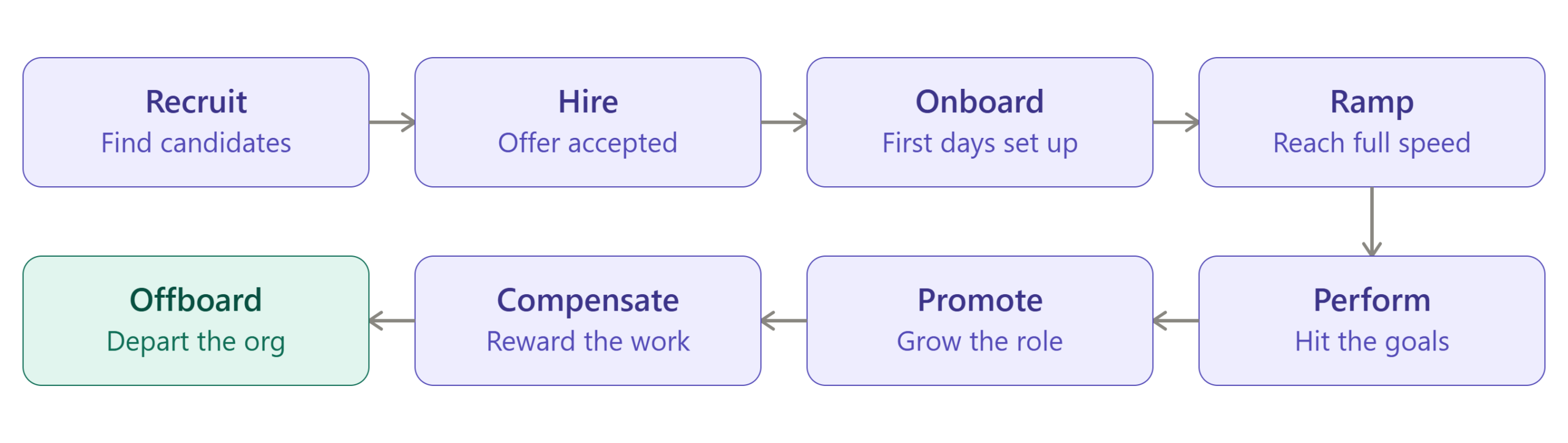
Then identify where spreadsheets or manual work exist.
Step 2: Identify the actual bottleneck
Don’t start with “Which HR software is best?”
Start with:
Which process is costing us the most time, money or risk?
Examples:
| Bottleneck | Likely solution |
| Payroll | Gusto / ADP / Paycom |
| HR administration | BambooHR / Rippling |
| Global employment | Deel |
| Performance reviews | Rippling / BambooHR / Paylocity |
| Workforce complexity | UKG |
| Commission calculations | CaptivateIQ / Performio |
| Prospecting | Salesloft / CRM |
| Pipeline management | Salesforce / HubSpot |
Step 3: Calculate Total Cost of Ownership
Don’t compare only subscription prices.
Calculate:
Software + implementation + integrations + administration + migration + support + additional modules
A $10-per-employee platform isn’t necessarily cheaper than a $15-per-employee platform if the first requires significantly more manual administration.
Step 4: Audit Integrations
Before purchasing, ask:
- Does it integrate with our CRM?
- Does it integrate with payroll?
- Does it integrate with our identity provider?
- Does it support APIs?
- Can employee changes trigger workflows?
- Can data flow into compensation software?
- Can sales managers access relevant employee information?
- Can permissions be role-based?
Step 5: Test a Real Sales Workflow
Don’t ask for a generic demo.
Give the vendor this scenario:
“A new account executive joins next Monday. Show us exactly what happens from signed offer through their first 30 days.”
Then test:
- onboarding
- payroll
- manager assignment
- permissions
- training
- goals
- compensation
- reporting
This reveals much more than a feature checklist.
AI and the Future of HR/Sales Automation
AI is rapidly becoming a standard layer across modern HR platforms.
Rippling currently promotes AI-assisted HR workflows and analytics, including workforce insights and automated employee-data actions.
BambooHR has embedded AI and describes capabilities such as natural-language analysis, recommendations and agentic workflows.
UKG similarly positions AI through Bryte AI for workforce insights and recommendations.
Deel uses AI for tasks such as drafting HR content and querying workforce data.
The most important trend isn’t “AI HR software.”
It is AI operating on connected workforce data.
That distinction matters.
An AI assistant that can see:
- employee role
- manager
- performance
- compensation
- tenure
- location
- training
can provide much more useful answers than a chatbot sitting on top of disconnected spreadsheets.
Frequently Asked Questions (FAQs)
What is the best HR software for sales automation in 2027?
Rippling is our overall pick because it combines HR, workforce, performance, compensation and automation capabilities particularly well. BambooHR is an excellent alternative for companies prioritizing usability, while Deel is stronger for global workforces.
Can HR software automate sales prospecting?
Usually no.
HR software manages employees and workforce processes. Prospecting is normally handled by CRM, sales-engagement or sales-automation software.
For example, Salesloft focuses on automating sales engagement and repetitive selling tasks.
Can HR software calculate sales commissions?
Sometimes, but sophisticated commission programs generally need specialized software.
If your organization has simple variable compensation, an HR/payroll platform may be enough.
For complex commission structures, dedicated platforms such as CaptivateIQ or Performio are designed specifically for incentive compensation.
What is the best HR software for a small sales team?
Gusto or BambooHR are strong starting points.
Gusto is particularly attractive for small U.S. companies that prioritize payroll and ease of use. BambooHR is better if performance management and broader HR functionality are higher priorities. Gusto currently publishes transparent plan pricing beginning at $49/month plus $6 per person.
What is the best HR software for a global sales team?
Deel is our first choice for global-first organizations.
Its platform combines HR, payroll, hiring, performance and compensation across international workers.
Rippling and UKG are also strong candidates depending on workforce structure and enterprise requirements.
Is Rippling better than BambooHR?
Neither is universally better.
Choose Rippling if workflow automation, integrations, IT and connected employee operations are priorities.
Choose BambooHR if you want a straightforward, user-friendly HR platform with strong performance and people-management capabilities.
Is BambooHR good for sales teams?
Yes.
BambooHR supports performance management, goals, 1:1s, hiring, onboarding, compensation and workforce reporting, making it useful as the HR foundation for a sales organization.
Should sales and HR use the same software?
Not necessarily.
They should share accurate data, but they do not necessarily need the same application.
A common architecture is:
HRIS + CRM + sales engagement + sales compensation + finance
The important thing is reliable integration.
What is the difference between HRIS and HCM?
An HRIS primarily manages core employee information and administrative HR processes.
An HCM generally encompasses a broader set of workforce-management and strategic capabilities, potentially including:
- performance
- learning
- compensation
- workforce planning
- analytics
- talent management
Modern vendors increasingly blur this distinction by offering comprehensive HR suites.
What HR software has the best automation?
Rippling and Paycom stand out for their automation-oriented architecture.
Rippling emphasizes cross-system workflows and a unified employee-data platform, while Paycom emphasizes automation across a single employee database.
Conclusion
Choosing the best HR software for sales automation in 2027 comes down to how well it supports your sales team’s growth, performance, and operations—not just basic HR tasks. Sales organizations need systems that connect onboarding, performance, compensation, and workforce data into streamlined, automated workflows.
Platforms like Rippling and Paycom offer deep automation, while BambooHR and Gusto prioritize simplicity. For global teams, Deel and HiBob stand out, while ADP Workforce Now, Paylocity, and UKG Pro deliver scalability and compliance. Personio fits structured SMB workflows.
Ultimately, the right choice transforms HR from a manual function into a scalable system that directly supports sales performance and revenue growth.
