
Ad revenue is the income a publisher, website, app, creator or digital platform earns by displaying or delivering paid advertisements to an audience. Advertisers pay for access to that audience using models such as CPM, CPC, CPA or fixed sponsorships, while publishers typically measure their monetization performance using metrics such as eCPM and RPM.
In simple terms:
Advertiser pays → Ad is delivered → User sees or interacts with it → Publisher earns revenue
The actual amount depends on traffic quality, advertiser demand, ad format, audience location, viewability, inventory, pricing model and the fees charged by advertising platforms.
What Is Ad Revenue? How It Works in 2026
Ad revenue, short for advertising revenue, is money earned from selling access to an audience through advertisements.
A website publisher may earn money when advertisements appear inside articles. A mobile app may monetize banner, native, interstitial or rewarded video placements. A video platform may place ads before or during videos. A media company may sell sponsorships directly to brands.
In each case, advertising turns audience attention or ad inventory into revenue.
Adjust defines ad revenue as income generated when advertisements are shown to users within digital environments such as websites, apps or platforms. AppsFlyer similarly describes it as income generated through advertising across the web, apps and connected digital environments.
Advertising remains a major part of the digital economy. The IAB/PwC Internet Advertising Revenue Report released in April 2026 reported that U.S. digital advertising revenue reached nearly $300 billion in 2025, representing 13.9% year-over-year growth.
But that industry figure should not be confused with what an individual publisher can earn. Publisher revenue varies dramatically depending on the audience and monetization setup.
How Does Ad Revenue Work?
Ad revenue works by connecting three fundamental parties:
Advertiser → Advertising system → Publisher
The advertiser wants access to potential customers.
The publisher has an audience.
The advertising system connects the two.
A simplified transaction looks like this:
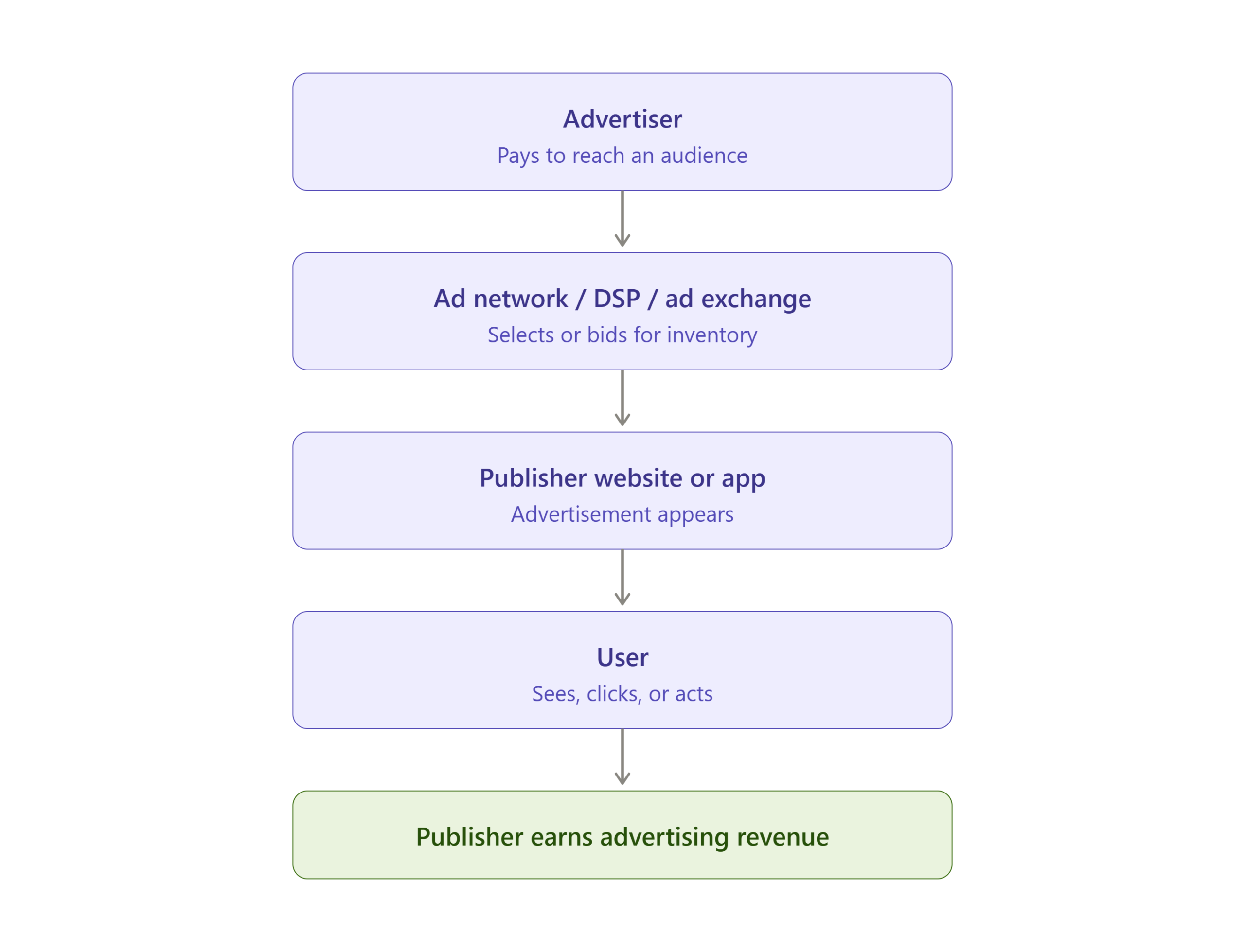
The actual process can be much more sophisticated, particularly in programmatic advertising, where auctions can happen automatically while a webpage is loading.
Who Actually Pays Ad Revenue?
The money ultimately originates with advertisers.
Suppose a software company wants to promote its new accounting platform. The company creates an advertising campaign and allocates a budget.
It might spend that budget through:
- Google Ads
- A demand-side platform
- An ad network
- A social advertising platform
- An agency
- A direct advertising agreement with a publisher
The publisher provides the advertising inventory.
Technology companies in the middle may facilitate the transaction and charge fees.
The remaining publisher share becomes advertising revenue.
This distinction matters because:
Advertiser Spend ≠ Publisher Revenue
For example, Google’s published AdSense for Content revenue structure states that publishers receive 80% of revenue after the advertiser platform takes its fee. When Google Ads purchases the inventory, Google said the combined structure would leave publishers with about 68% of advertiser revenue overall.
Different networks, exchanges and direct agreements use different fee structures.
What Is Ad Inventory?
Ad inventory is the advertising space or opportunity a publisher makes available for advertisers to buy.
On a website, inventory could include:
- A banner below the page header
- An advertisement inside an article
- A sidebar placement
- A sticky advertisement
- A native advertising unit
- A video advertising placement
Inside an app, inventory may include banners, native units, interstitials or rewarded video.
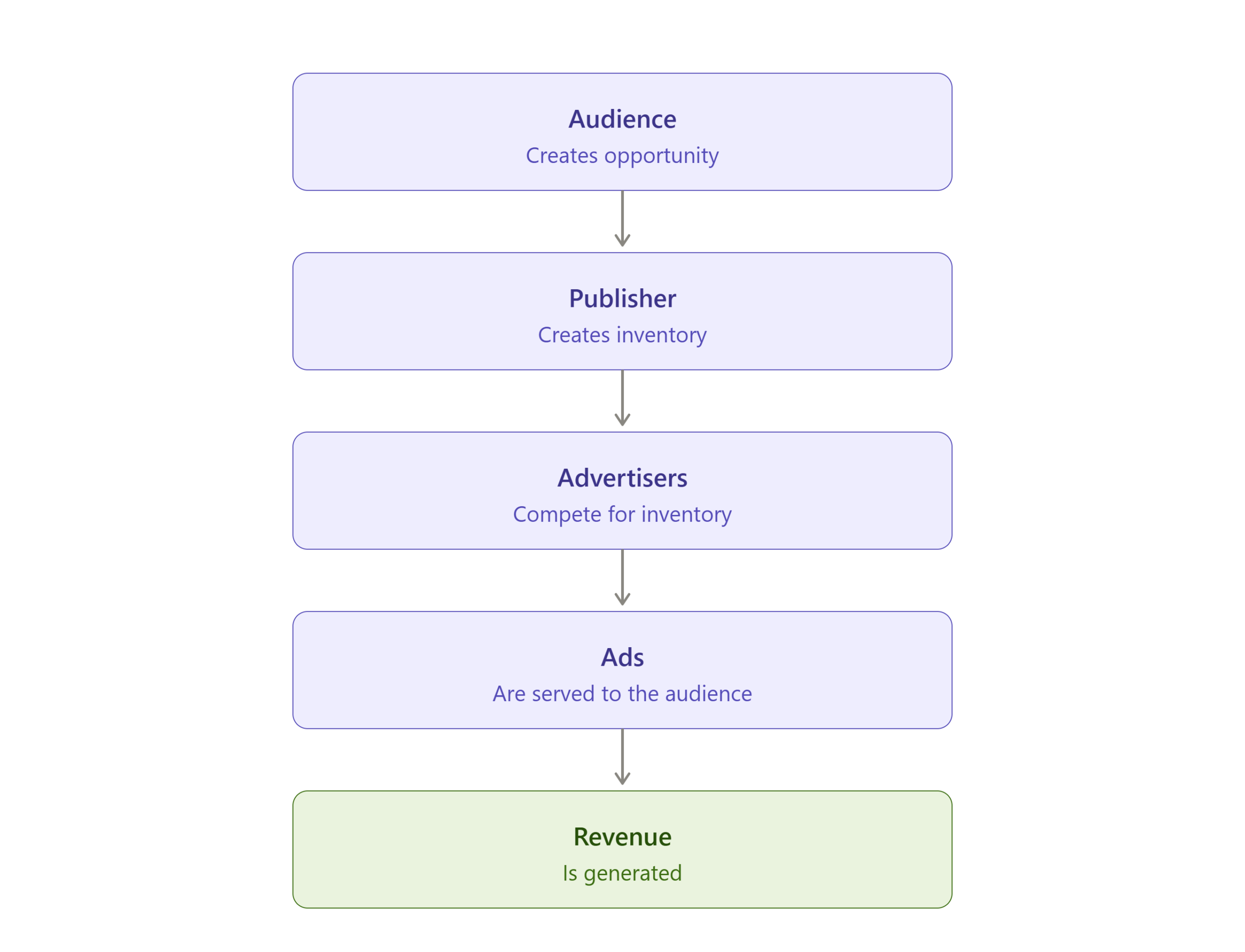
Inventory does not automatically generate money simply because it exists. There must also be advertising demand for it.
You can think of it this way:
How Programmatic Advertising Generates Ad Revenue
A large portion of digital advertising transactions are automated through programmatic advertising.
Programmatic advertising uses advertising technology to automatically buy and sell digital ad inventory. Amazon Ads describes the process as an automated transaction in which publisher inventory can be offered through a supply-side platform, while demand-side platforms bid on behalf of advertisers.
A simplified programmatic transaction looks like this:
Step 1 — A User Opens a Page
Someone visits a publisher’s website or opens an app.
Step 2 — The Publisher Creates an Ad Request
The page contains an available advertising slot.
The publisher’s advertising system announces that an impression may be available.
Step 3 — Buyers Evaluate the Impression
Advertisers or demand-side platforms evaluate signals associated with that advertising opportunity.
Depending on the system and available permissions, those signals may include factors such as the content, device, location, placement and campaign requirements.
Step 4 — Advertisers Bid
Eligible advertisers submit bids.
The auction can happen almost instantly.
Step 5 — A Winning Advertisement Is Selected
The advertising system chooses an eligible advertisement according to the auction and campaign rules.
Step 6 — The Ad Is Delivered
The advertisement loads in the publisher’s available inventory.
Step 7 — Revenue Is Recorded
If the impression, click, view, action or other billable event satisfies the applicable pricing and validity rules, revenue can be attributed to the publisher.
Amazon Ads describes a similar real-time flow in which publishers offer an impression through SSPs, DSPs bid on behalf of advertisers and the winning advertiser’s creative is served.
The Main Ad Revenue Models
Publishers do not always earn money in the same way.
Google Ad Manager, for example, supports advertiser pricing models including CPM, CPC, CPA, CPD, vCPM and cost per completed video view for applicable campaigns.
Understanding these models is essential because they determine what event creates value.
CPM — Cost Per Thousand Impressions
CPM stands for cost per mille, with “mille” meaning one thousand.
An advertiser using CPM pays according to the number of impressions delivered.
If a publisher receives a $5 CPM:
100,000 impressions ÷ 1,000 × $5 = $500
The example is hypothetical and ignores platform fees or other adjustments.
CPM is especially common in display and programmatic advertising.
vCPM — Viewable Cost Per Thousand Impressions
vCPM focuses on viewable impressions rather than simply served impressions.
This matters because loading an advertisement somewhere on a webpage does not necessarily mean that a visitor actually had an opportunity to see it.
Google’s Active View documentation defines a display impression as viewable when at least 50% of the advertisement’s area is visible for at least one second. For in-stream video, the minimum duration is two seconds.
That is why viewability is an important publisher monetization metric.
CPC — Cost Per Click
With CPC advertising, the billable event is a valid click.
A simplified revenue calculation is:
Revenue = Valid Clicks × CPC
Hypothetical example:
500 valid clicks × $0.60 CPC = $300
The exact amount a publisher receives depends on the advertising system and revenue-sharing arrangement.
CPA — Cost Per Action or Acquisition
Under a CPA model, payment occurs when the user completes a defined conversion.
The action could be:
- A purchase
- A registration
- A qualified lead
- An app install
- Another specified conversion
Google Ad Manager defines CPA as cost per action, where the action is a conversion taken after viewing or clicking an advertisement.
CPA shifts more performance risk toward the publisher because impressions or clicks alone may not generate revenue.
CPD — Cost Per Day
CPD means cost per day.
Instead of paying for each individual impression or click, an advertiser pays a negotiated amount for advertising exposure over a defined period.
This model may be used for direct sponsorships, homepage takeovers or other reservation-based advertising agreements.
Google Ad Manager includes CPD among its supported line-item pricing methods.
What Is eCPM?
eCPM, or effective cost per thousand impressions, shows how much revenue a publisher effectively earns for every 1,000 ad impressions.
It allows publishers to compare inventory even when different campaigns use different payment models.
The simplified formula is:
eCPM = Revenue ÷ Ad Impressions × 1,000
Google Ad Manager uses this same relationship when calculating Ad Exchange average eCPM.
Example
Suppose a website generates:
- 250,000 ad impressions
- $1,000 in advertising revenue
Then:
$1,000 ÷ 250,000 × 1,000 = $4 eCPM
This means the inventory effectively generated $4 for every 1,000 impressions.
What Is RPM?
RPM, or revenue per thousand, is a publisher performance metric showing estimated revenue for every 1,000 pageviews, impressions or other specified units.
Google AdSense calculates page RPM as:
RPM = Estimated Earnings ÷ Pageviews × 1,000
For example, if a website earns $800 from 100,000 pageviews:
$800 ÷ 100,000 × 1,000 = $8 Page RPM
One important distinction is frequently missed:
RPM is not the same thing as CPM.
CPM usually describes the price of advertising inventory.
RPM describes the publisher’s revenue performance.
Google also notes that RPM itself does not represent the amount actually earned; it is a calculated metric used to compare performance.
CPM vs eCPM vs RPM
These three terms are closely related but answer different questions.
CPM asks: What is the price for 1,000 advertising impressions?
eCPM asks: What did the publisher effectively earn for 1,000 ad impressions?
RPM asks: How much estimated revenue was generated per 1,000 pageviews, impressions or another reporting unit?
Understanding that distinction prevents one of the most common mistakes beginners make when evaluating advertising revenue.
How to Calculate Ad Revenue
There is no single universal equation because publishers may earn through several pricing models simultaneously.
For impression-driven advertising, a useful simplified formula is:
Ad Revenue = Ad Impressions ÷ 1,000 × eCPM
Hypothetical Example
A publisher generates:
500,000 monthly ad impressions
at an average:
$6 eCPM
Calculation:
500,000 ÷ 1,000 × $6
=
$3,000 estimated advertising revenue
This is a simplified example. Actual dashboard revenue may be affected by advertising technology fees, invalid traffic adjustments, reporting methodology and other contractual factors.
Page RPM Revenue Calculation
Publishers looking at traffic rather than individual ad impressions can use page RPM.
The simplified relationship is:
Estimated Revenue = Pageviews ÷ 1,000 × Page RPM
Suppose a website generates:
200,000 monthly pageviews
with:
$12 Page RPM
Estimated revenue:
200,000 ÷ 1,000 × $12
=
$2,400
Again, this is a planning calculation rather than a guarantee.
Is Ad Revenue the Same as Profit?
No. Ad revenue is income from advertising; profit is what remains after relevant expenses are deducted.
A publisher might generate:
$10,000 advertising revenue
but spend:
- $3,000 on writers
- $1,000 on development
- $700 on hosting and technology
- $1,300 on staff and other operating costs
The business’s actual profit would therefore be substantially lower than its advertising revenue.
This distinction becomes especially important when comparing monetization strategies.
A website earning a higher RPM is not automatically the more profitable business if acquiring and retaining its traffic costs significantly more.
Ad Revenue vs Ad Monetization
These terms are related but not interchangeable.
Ad monetization is the process.
Ad revenue is the financial result.
A publisher’s monetization strategy may involve:
Traffic → Inventory → Advertising Demand → Ad Delivery → Revenue
The better that system performs, the greater the potential revenue.
What Determines How Much Ad Revenue You Earn?
Two websites with the same number of visitors can produce very different advertising results.
Traffic volume matters, but it is only one variable.
Audience Quality
Advertisers do not value every audience equally.
Users who match valuable advertiser segments or demonstrate stronger commercial intent can attract stronger bidding competition.
Traffic quality also matters from a validity perspective. Google defines invalid traffic as clicks or impressions that may artificially increase advertiser costs or publisher earnings.
Audience Geography
Advertiser demand differs by country and market.
A publisher should therefore analyze revenue by geography rather than assuming every 1,000 visitors have the same monetary value.
Content Topic
Advertiser demand varies significantly across industries.
Content closely connected to valuable commercial decisions can attract different advertising competition than general entertainment content.
The appropriate question is not simply:
“Which niche has the highest CPM?”
It is:
“How much advertiser demand exists for my particular audience and inventory?”
Ad Viewability
An ad can technically load without being meaningfully visible.
Viewability therefore influences the quality and potential value of advertising inventory.
Google states that measuring viewability helps publishers and advertisers assess the value of impressions.
Ad Format
Different formats create different levels of user attention and advertiser demand.
Common formats include:
- Display advertising
- Native advertising
- Video advertising
- Interstitial advertising
- Rewarded video
- Sponsored placements
AppsFlyer and Adjust both identify banner, native, video and other formats as common components of digital advertising monetization.
Advertiser Competition
More eligible buyers competing for an impression can create greater auction pressure.
This is why publishers often focus not simply on adding more advertisements but on improving access to quality advertising demand.
Fill Rate
A publisher may have advertising space without receiving a paid advertisement for every request.
A basic fill or delivery calculation compares the number of impressions delivered with the number of advertising requests. Google Ad Manager describes Ad Exchange delivery rate as ad impressions divided by ad requests.
Low fill can reduce revenue even when traffic remains stable.
Seasonality
Advertising demand changes throughout the year.
Budgets, promotions, product launches and commercial events can affect advertiser competition.
Publishers should therefore compare performance year over year where possible instead of treating one strong or weak month as a permanent benchmark.
User Experience
More advertisements do not automatically mean more long-term revenue.
Aggressive advertising can reduce:
- Reading time
- Pages per session
- Repeat visits
- Content engagement
- Overall site usability
The stronger strategy is usually to maximize the value of each session, not simply the number of advertisements on each page.
How Do Websites Start Making Ad Revenue?
The implementation differs by platform, but the core process is straightforward.
Step 1 — Build a Monetizable Audience
Advertising requires attention.
Publish useful content or provide a useful product that attracts genuine visitors.
Without sustainable traffic, advertising inventory has limited scale.
Step 2 — Choose a Monetization Method
A publisher can monetize through:
- Ad network: Simple access to advertiser demand.
- Programmatic platform: Automated competition across advertising inventory.
- Direct advertising: Publisher negotiates directly with advertisers.
- Sponsorships: Brands pay for specific placements, content or time periods.
Many established publishers use more than one method.
Step 3 — Create Advertising Inventory
Identify placements where ads can appear without undermining the main content.
For a content website, this might include:
- Above-content placement
- In-content units
- Sidebar inventory
- Below-content placements
- Video inventory
Placement should consider both revenue and user experience.
Step 4 — Implement Advertising Technology
The publisher adds the appropriate advertising tags, SDK, plugin or platform integration.
The technology sends advertising requests and delivers eligible ads.
Step 5 — Monitor Delivery
Once ads begin serving, confirm that:
- Ad requests are being generated
- Ads actually render
- Impressions are recorded
- Inventory is measurable
- Revenue appears in reporting
Do not judge performance from traffic alone.
Step 6 — Measure Revenue Correctly
Track at least:
- Total ad revenue
- Page RPM
- Ad RPM or eCPM
- Impressions
- Pageviews
- Fill or delivery rate
- Viewability
- Traffic by country
- Device
- Page or content category
These metrics reveal why revenue changed instead of simply showing that it changed.
Step 7 — Optimize Without Damaging the Audience
Improve revenue through controlled testing.
Test:
- Placement
- Format
- Demand partners
- Viewability
- Content engagement
- Page speed
- Inventory structure
The goal is sustainable monetization rather than maximum short-term ad exposure.
Does Google AdSense Still Pay for Clicks in 2026?
For AdSense for Content, Google’s publisher monetization structure transitioned away from primarily paying publishers per click toward paying on an impression basis.
Google announced the change in 2023, explaining that impression-based payments would align AdSense more closely with the broader display advertising industry. Google’s related AdSense documentation distinguishes this change from AdSense for Search.
That does not mean clicks are irrelevant to digital advertising.
CPC remains a legitimate campaign-pricing model in platforms such as Google Ad Manager.
It simply means publishers should not assume that every advertising platform or publisher product pays according to clicks.
Benefits of the Ad Revenue Model
Advertising allows publishers to monetize an audience without requiring every visitor to purchase something directly.
It can provide:
- Scalable monetization as traffic grows
- Free or low-cost access to content for users
- Revenue from existing content and audience attention
- Multiple advertising formats
- Automated monetization through programmatic systems
- A revenue stream that can complement subscriptions, affiliate marketing or products
For many publishers, this flexibility is the main attraction.
Limitations of Advertising Revenue
Ad revenue also has trade-offs.
Revenue can fluctuate because of changes in:
- Traffic
- Advertiser demand
- Seasonality
- Audience composition
- Viewability
- Fill rate
- Platform policies
- Invalid traffic adjustments
- User behavior
Publishers using networks also surrender some control over which advertisers purchase inventory.
The business therefore becomes stronger when advertising is treated as one part of a broader monetization strategy rather than guaranteed income.
Relevant Tables and Frameworks
Ad Revenue Models Compared
Model |
Publisher Earns When |
Basic Formula |
Best Understood As |
|---|---|---|---|
| CPM | Impressions are delivered | Impressions ÷ 1,000 × CPM | Impression pricing |
| vCPM | Viewable impressions qualify | Viewable impressions ÷ 1,000 × vCPM | Viewability-based pricing |
| CPC | User clicks | Valid clicks × CPC | Click-based pricing |
| CPA | User completes an action | Conversions × CPA | Performance pricing |
| CPD | Ad runs for agreed period | Days × daily rate | Time-based pricing |
| Fixed Sponsorship | Contractual placement is provided | Negotiated | Direct advertising |
Google Ad Manager formally recognizes CPM, CPC, CPD, CPA and vCPM among its available rate structures.
CPM vs eCPM vs RPM
Metric |
What It Measures |
Primary Perspective |
| CPM | Price per 1,000 impressions | Advertiser / campaign |
| eCPM | Effective revenue per 1,000 ad impressions | Publisher |
| Ad RPM | Estimated revenue per 1,000 ad impressions | Publisher |
| Page RPM | Estimated revenue per 1,000 pageviews | Publisher |
Google defines RPM as estimated earnings divided by the appropriate number of views or impressions, multiplied by 1,000.
The Ad Revenue Value Chain
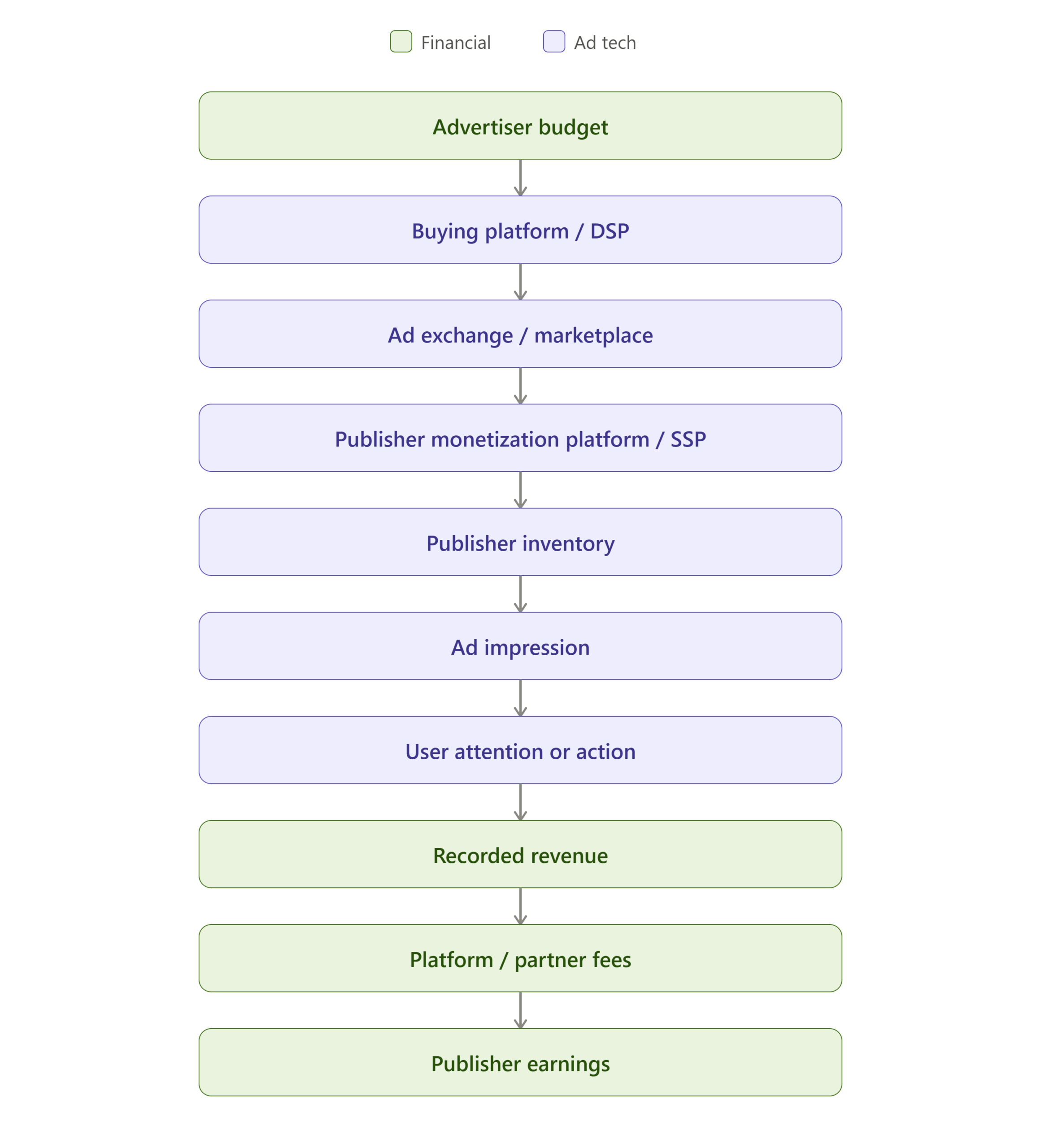
Not every advertising transaction includes every intermediary. Direct advertising can shorten this chain considerably.
Troubleshooting: Why Is My Ad Revenue Low?
Low revenue should be diagnosed systematically rather than solved by immediately adding more advertisements.
Problem |
What to Check |
Likely Explanation |
Action |
| Traffic stable, revenue down | eCPM/RPM | Advertising value declined | Segment by country, device, format and demand source |
| Pageviews down | Analytics | Less audience volume | Investigate traffic loss |
| High requests, few impressions | Fill/delivery rate | Inventory is not consistently filled | Review demand and ad delivery |
| Good impressions, weak revenue | eCPM | Low advertiser competition or inventory value | Improve demand competition and inventory quality |
| Low viewability | Viewability reports | Ads load where users rarely see them | Test better placements |
| Sudden earnings adjustment | Invalid traffic reporting | Invalid impressions/clicks may have been removed | Audit traffic sources |
| Revenue increases but engagement falls | UX metrics | Ad load may be too aggressive | Optimize revenue per session instead of ad count |
| One country performs poorly | Geographic RPM | Demand differs by market | Segment rather than applying one global benchmark |
Google states that invalid traffic includes impressions or clicks that artificially inflate advertiser costs or publisher earnings, and publishers do not receive revenue for invalid clicks.
Expert Insights
1. Do Not Optimize Ad Count—Optimize Revenue per Session
Increasing ad density can raise the number of available impressions while simultaneously reducing user engagement.
If a visitor views:
1 page × 8 ads
that is not automatically more valuable than:
3 pages × 4 well-performing ads
The second scenario may create more total monetizable opportunities while preserving a better experience.
The metric that ultimately matters is the total sustainable value created by the audience.
2. Separate Traffic Problems From Monetization Problems
Use this diagnostic model:
Traffic
×
Advertising Opportunities
×
Fill
×
Inventory Value
=
Revenue Potential
When revenue falls, identify which part changed.
Did traffic decline?
Did fewer ads serve?
Did viewability fall?
Did advertiser bids weaken?
Did the traffic mix change?
This is far more useful than simply asking:
“Why is my RPM low?”
3. Segment Before You Optimize
A site-wide RPM hides important differences.
Analyze monetization by:
Country → Device → Page Type → Traffic Source → Ad Format
For example, an apparent site-wide revenue decline might actually be caused by a larger percentage of traffic coming from a lower-value geography.
Without segmentation, publishers may incorrectly change their entire advertising setup.
4. Treat Viewability as Inventory Quality
Two ad placements can receive the same number of requests but have different value.
An ad that loads near content users actively consume may be more valuable than one that technically loads far below the point most visitors reach.
Google’s viewability documentation explicitly notes that viewability helps publishers and advertisers evaluate the value of impressions.
5. Revenue and Audience Quality Must Grow Together
A sustainable advertising business needs both:
Monetization Efficiency + Audience Growth
Improving RPM without growing useful traffic limits scale.
Growing traffic while ignoring monetization leaves revenue unrealized.
Strong publishers work on both simultaneously.
Implementation Checklist
Before Monetization
- Define your audience and content model
- Confirm your website or app has genuine user value
- Choose an appropriate advertising partner
- Understand the partner’s eligibility and traffic policies
- Decide which pages and placements should contain advertisements
During Setup
- Implement ad tags or SDKs correctly
- Test mobile and desktop layouts
- Confirm ads load properly
- Protect the primary content experience
- Monitor page performance
- Follow relevant privacy, consent and advertising requirements
After Launch
- Verify impressions are recorded
- Verify revenue reporting
- Track page RPM
- Track eCPM or ad RPM
- Monitor fill/delivery
- Monitor viewability
- Segment revenue by geography and device
- Investigate unusual traffic patterns
- Test placements rather than making uncontrolled changes
- Compare monetization trends over meaningful time periods
Frequently Asked Questions
What is ad revenue in simple terms?
Ad revenue is money earned by showing or delivering paid advertisements to an audience. Websites, apps, video platforms and other publishers provide advertising inventory, while advertisers pay to reach their users.
How is ad revenue calculated?
For impression-based monetization, a useful formula is:
Ad Revenue = Impressions ÷ 1,000 × eCPM
For website-level analysis, estimated revenue can also be calculated using:
Pageviews ÷ 1,000 × Page RPM
Google defines page RPM as estimated earnings divided by pageviews and multiplied by 1,000.
What is the difference between ad revenue and CPM?
Ad revenue is the money a publisher earns from advertising. CPM is a pricing measure representing cost per thousand impressions. A publisher may generate revenue from CPM advertising as well as CPC, CPA, fixed sponsorships and other arrangements.
What is the difference between CPM and RPM?
CPM generally describes the price of 1,000 ad impressions, while RPM describes the estimated revenue generated per 1,000 pageviews or impressions.
RPM is therefore primarily a publisher performance metric rather than a separate advertiser payment model.
How much ad revenue can a website make?
There is no reliable universal amount.
Website advertising revenue depends on traffic volume, audience geography, advertiser demand, content, ad formats, viewability, fill, seasonality and monetization partners.
A more useful approach is to estimate revenue using your own pageviews and RPM rather than relying on generic “earnings per 1,000 visitors” claims.
Can a small website earn ad revenue?
Yes, a small website can technically generate advertising revenue if it qualifies for a monetization service and has valid monetizable traffic.
However, smaller traffic volume naturally limits total revenue even when RPM is strong.
For early-stage publishers, building useful content and a sustainable audience is usually more important than maximizing ad density.
Why does ad revenue change even when traffic stays the same?
Because traffic volume is only one part of the equation.
Ad revenue can change because of advertiser competition, audience geography, traffic mix, seasonality, viewability, fill, formats, auction conditions or invalid-traffic adjustments.
Analyze RPM and monetization metrics alongside traffic before diagnosing the problem.
Does AdSense pay publishers per click in 2026?
For AdSense for Content, Google transitioned its publisher compensation structure from primarily click-based payments to impression-based payments. CPC still exists as an advertising pricing model elsewhere in the ecosystem, but publishers should not assume every AdSense click directly creates a separate publisher payment.
Final Takeaway
Ad revenue is the income publishers earn by giving advertisers access to their audiences through advertising inventory.
The basic ecosystem is:
Audience → Inventory → Advertiser Demand → Ad Delivery → Revenue
But traffic alone does not determine earnings.
Publisher revenue depends on the combined strength of:
Traffic Quality + Advertiser Demand + Inventory + Viewability + Fill + Pricing + User Experience
CPM, CPC, CPA and similar models explain how advertising is priced, while eCPM and RPM help publishers understand how effectively their inventory generates revenue.
For publishers in 2026, the strongest strategy is therefore not simply to display more ads.
It is to build a valuable audience, create high-quality advertising inventory, increase legitimate demand, monitor the correct metrics and improve revenue without damaging the user experience.
