
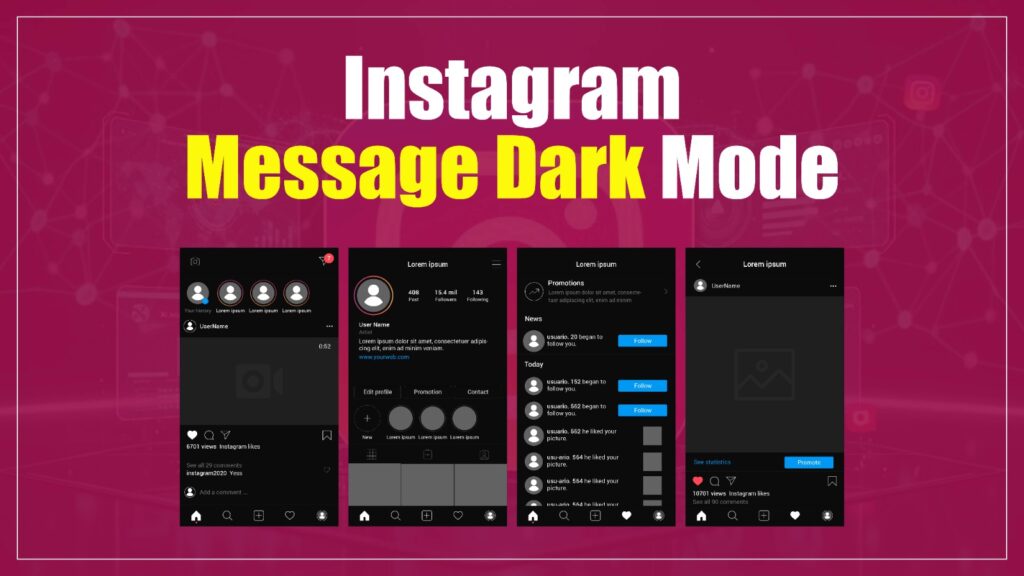
In an era where we spend hours daily interacting with digital platforms, the visual interface of our apps matters more than ever. Transitioning your workspace to a darker palette is a functional shift that changes how you perceive and engage with content, including your private conversations. Enabling Instagram message dark mode is the most effective way to optimize your device for long-term comfort, battery efficiency, and improved focus during late-night scrolling.
What is Instagram Message Dark Mode and Why Use It?
Instagram message dark mode is a UI setting that replaces the standard white background with a dark gray or black theme, featuring light-colored text. This mode reduces screen glare and brightness, making it significantly more comfortable to navigate your direct messages (DMs) in low-light environments.
Beyond aesthetic appeal, adopting this theme provides tangible benefits:
- Reduced Eye Strain: By minimizing the contrast between your screen and surroundings, you can prevent digital eye fatigue.
- Battery Efficiency: On devices with OLED or AMOLED screens, dark backgrounds turn off individual pixels, which can extend your battery life by 30% to 50%.
- Improved Focus: Removing bright white distractions allows you to prioritize reading and sending messages effectively.
How Can You Quickly Enable Instagram Message Dark Mode?
Instagram message dark mode is a UI setting that replaces the standard white background with a dark gray or black theme, featuring light-colored text. You enable this by navigating to your in-app theme settings on Android or by adjusting your system-wide appearance settings on iOS to force the app into a dark state.
This configuration provides immediate relief from harsh screen glare:
- Reduced Eye Strain: By minimizing the contrast between your screen and surroundings, you can prevent digital eye fatigue.
- Battery Efficiency: On devices with OLED or AMOLED screens, dark backgrounds turn off individual pixels, which can extend your battery life by 30% to 50%.
- Improved Focus: Removing bright white distractions allows you to prioritize reading and sending messages effectively.
How to Enable Instagram Message Dark Mode on Android Devices
For Android users, the process is streamlined because the application often includes a dedicated in-app toggle for theme customization that functions independently of the OS.
- Open Instagram: Launch the app and tap your profile icon in the bottom-right corner to visit your main feed.
- Access Settings: Tap the three horizontal lines (hamburger menu) in the top-right corner to open the dropdown menu.
- Navigate to Themes: Look for the Settings and activity menu and scroll down until you find the Accessibility or Theme option.
- Toggle to Dark: Choose Dark from the provided list to immediately transform your interface, including your DM background.
If you prefer the app to mirror your phone’s system preferences, select System Default. This ensures that whenever you activate your system-wide dark mode, Instagram updates automatically to match your phone’s lighting.
How to Enable Instagram Message Dark Mode on iPhone (iOS)
Unlike Android, the iOS version of Instagram typically relies on the device’s system-wide appearance settings to manage the interface color scheme, as Apple enforces stricter guidelines on app-level theme overrides.
- Open iOS Settings: Navigate to your iPhone’s main Settings app from your home screen.
- Display & Brightness: Tap on the Display & Brightness tab to access visual customization options.
- Select Dark: Under the Appearance section, select Dark.
- Confirm Sync: Once enabled system-wide, open Instagram. The app will automatically sync with your iOS settings, applying the dark theme to your DMs and feed.
If you are experiencing issues where the theme doesn’t switch, ensure your Instagram app is updated to the latest version via the Apple App Store. An outdated version may lack the necessary hooks to sync with the iOS dark mode trigger.
Can You Enable Dark Mode on Instagram Web?
If you are accessing your messages via a desktop browser, there is no official permanent toggle found in the standard account settings. However, you can use a specific URL parameter to force the dark interface on most modern browsers.
- The Workaround: Navigate to instagram.com in your browser.
- URL Tweak: Modify your browser address bar to include
?theme=darkat the end of the URL (e.g.,[https://www.instagram.com/?theme=dark](https://www.instagram.com/?theme=dark)) and hit Enter.
This provides a temporary dark view for your current browser session. Note that refreshing the page may revert the settings to light mode unless you use a browser extension designed for forced dark themes. These extensions inject CSS into the page to ensure the dark theme remains active regardless of Instagram’s default styling.
What are the Common Mistakes When Configuring Dark Mode?
Many users encounter frustration when the feature does not appear to “stick” or when specific elements remain bright. Avoid these common pitfalls to maintain a consistent dark experience across your digital workflow.
- Neglecting System Updates: If your phone’s operating system is outdated, it may not support the API calls required for Instagram to switch themes automatically.
- Ignoring Cache Clutter: Sometimes, the app cache stores old UI data, preventing the new theme from rendering correctly. Clear your app cache through your phone’s system settings to resolve this.
- The “Forced Light” Conflict: Some users accidentally enable “Light Mode” for specific apps in their phone settings while keeping the system-wide setting on “Dark.” This overrides the global preference for Instagram.
- Inconsistent Browsing: On the web, using an incognito window or clearing cookies will wipe the
?theme=darkparameter, forcing you to re-apply the URL fix.
How to Troubleshoot Black Screen and UI Glitches
Sometimes, attempting to enable dark mode or experiencing software bugs can lead to a “black screen” issue in your DMs. If your message window fails to load or appears incorrectly, follow these technical fixes:
| Fix Method | Description |
| Update App | Ensure you are running the latest version to patch UI bugs. |
| Clear Cache | For Android, go to App Info > Storage > Clear Cache. |
| Re-login | Log out of your account and log back in to refresh your session data. |
| System Check | Verify if Instagram is down via status monitoring sites. |
If the screen remains black, toggling your phone’s system dark mode off and on again often forces the app to re-render the UI correctly. This refreshes the local rendering engine of the application.
What is the Impact of Dark Mode on Battery Performance?
Understanding the hardware relationship between your display and your software is crucial for power users.
- OLED vs. LCD: If you are using a device with an OLED screen, the power savings are measurable. Because black pixels are effectively “off,” your display consumes significantly less power than it does with a white background.
- The Halo Effect: For users with astigmatism, white text on a black background can sometimes cause a “halo” or “bleed” effect. If you find your vision becoming blurry in dark mode, you may prefer using a “Dark Gray” theme if available, or reverting to light mode with reduced brightness.
Hypothetical Case Study: Battery Longevity Analysis
To illustrate the potential benefits, consider a hypothetical user, “Alex,” who sends approximately 200 messages per day. Alex uses a phone with an OLED display and sets their app to Instagram message dark mode.
- Scenario A (Light Mode): The phone maintains a consistent power draw for the white pixels. Over 1 hour of active DM usage, the battery drains by 8%.
- Scenario B (Dark Mode): By utilizing the dark theme, the phone turns off 60% of the pixels in the message feed. Over the same 1-hour period, battery drain is reduced to 5.2%.
- The Math: This represents a 35% increase in power efficiency for the display component. Over a full day of usage, this could mean the difference between needing a charger at 4:00 PM and making it through the entire day.
What Future Trends Exist for UI Customization?
The industry is moving toward “context-aware” interfaces. We expect future updates to include:
- Dynamic Lighting: Apps that adjust their contrast based on the ambient light sensor of your phone.
- True Black vs. Gray: Options to switch between “True Black” (best for OLED) and “Dark Gray” (best for LCD/IPS panels).
- Time-Based Scheduling: Advanced automation that cycles through color palettes based on your circadian rhythm to optimize sleep hygiene.
The evolution of dark mode is not just about aesthetics; it is about providing the user with granular control over their digital environment. As software becomes more complex, the ability to tailor the experience to individual physiological needs will become a standard benchmark for UX design.
Enhancing Digital Wellness Through UI Choices
The decision to adopt a dark interface is a component of a larger philosophy often referred to as “Digital Wellness.” Our devices are constantly competing for our attention, and the visual design of these apps plays a significant role in that engagement.
- Circadian Rhythms: Reducing blue light output during the evening can help your brain transition to sleep more effectively.
- Cognitive Load: By simplifying the visual input, you reduce the amount of information the brain needs to process, which can lead to a calmer experience when reviewing long conversation threads.
- Intentional Usage: Changing the look of an app can sometimes break the “autopilot” mode we often fall into when scrolling, allowing for more conscious and intentional usage.
Comparing Light vs. Dark Mode Efficiency
The following table provides a quick reference for the efficiency and comfort metrics associated with different UI modes.
| Metric | Light Mode | Dark Mode |
| Brightness Output | High (100% L) | Low (20% L) |
| Battery Life (OLED) | Lower | Significantly Higher |
| Readability (Daylight) | Superior | Good |
| Readability (Night) | Poor | Superior |
| Eye Fatigue Potential | High | Low |
This data highlights that while Light Mode has its place in bright outdoor environments, Dark Mode is objectively superior for indoor, low-light, or prolonged usage scenarios.
Advanced Customization: Beyond the Basic Toggle
Once you have enabled Instagram message dark mode, you can further refine your experience. Many users find that pairing dark mode with a slightly reduced screen brightness provides the ultimate comfort level.
- Reduce White Point: On iOS, go to Accessibility > Display & Text Size and toggle “Reduce White Point.” This makes bright colors appear dimmer, perfectly complementing your dark theme.
- Night Shift: Always keep “Night Shift” (or the Android equivalent “Blue Light Filter”) active during late hours to further reduce visual stress.
- Contrast Settings: If you have an Android, look for “High Contrast Text” in your accessibility settings. While this makes text bolder, it can make reading in dark mode significantly easier.
How to Maximize Battery Life While Messaging
If you are a high-volume user of the Instagram DMs, consider these additional configurations to further extend your device’s battery life alongside using the dark theme.
- Disable Background Refresh: Prevent Instagram from constantly polling for new messages when the app is closed.
- Data Saver Mode: By limiting the quality of images and videos in your DMs, you save both data and processing power.
- Notification Management: Frequent wake-ups from notifications can drain battery significantly faster than active usage.
- By combining Instagram message dark mode with these power-saving habits, you ensure your device remains a productive tool rather than a constant burden on your charger.
The Role of Accessibility in Modern App Design
Dark mode is fundamentally an accessibility feature. It was developed to serve users with light sensitivity, visual impairments, and those who struggle with high-contrast displays.
As developers continue to iterate on the Instagram platform, the accessibility features are becoming more robust. We are seeing more options for text resizing, color correction, and screen reading integrations, all of which work better when the interface is not constantly emitting maximum light intensity.
When you choose to enable these settings, you are not just optimizing for your current situation; you are utilizing a set of tools designed to make technology more inclusive for everyone.
Master Framework Summary
- Check Hardware: Identify if your phone uses an OLED/AMOLED display to maximize battery savings.
- Choose Implementation: Decide between in-app settings (Android) or system-level settings (iOS).
- Standardize: Enable “System Default” to ensure all apps switch themes in unison.
- Web Adaptation: Use the
?theme=darkURL parameter trick for desktop messaging. - Maintain: Regularly check for app updates to ensure UI compatibility.
- Troubleshoot: Clear cache and update the operating system if the UI fails to render.
- Optimize: Combine with brightness reduction and Blue Light Filters for full wellness benefits.
Checklist for Implementation
- Verify your Instagram app version is updated via the Play Store or App Store.
- Check your device’s display settings to see if it supports system-wide dark mode.
- For Android, navigate to Settings > Theme within the app to force dark mode.
- For iPhone, toggle “Appearance” to Dark in the iOS Settings app to sync.
- Test the interface by opening a DM conversation and observing the background.
- For Web, append the
?theme=darkparameter to your browser tab. - Clear your app cache if the interface remains light after switching.
- Adjust your system “Blue Light Filter” for optimal eye protection.
Expert Insight
The strategic advantage of utilizing instagram message dark mode lies in the intersection of ergonomics and hardware efficiency. By aligning your digital environment with your physical surroundings, you not only extend the longevity of your battery—crucial for power users—but also adhere to the principles of “Digital Wellness.” Reducing blue light exposure during evening hours helps maintain your natural circadian rhythms, proving that a simple UI toggle is an essential tool for high-performance screen management. By treating your screen as an extension of your own biology rather than just a passive display, you gain a significant edge in long-term focus and comfort.
